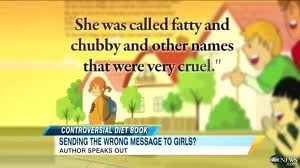
There are two significant problems with a book like Maggie Goes on a Diet, which is pitched at pre-teens and preaches dieting as the best form of weight loss.
The first problem is that young children should not be dieting. On the child related health website, Kidshealth.org, it states that, “Diets that don’t include a variety of nutritious foods, or have too few calories, can be dangerous for kids.”
My second concern is the type of messages we send kids about weight. At a time when these young children are trying to work out who they are and trying to find a sense of self it is terribly destructive to focus on their weight. Children who need to lose weight don’t need a novel to tell them that. They need a support network of loving parents and dietitians who will be able to consider the child’s virtues as well as their struggles.
As much as childhood obesity is a concern, in my view children lacking in confidence is of far greater concern. It is not sufficient to tear down a childs self-esteem by recommending diets and drawing attention to their weight. To be motivated to do anything positive one has to be in a positive mindframe. You have to believe in yourself and think of yourself as worthy of the breakthrough.
I too have written a book (albeit not yet published) that focusses on an obese child. But I have taken a very different approach. My child learns not to obsess about his weight and see the bigger picture. He is not going to get thin tomorrow, but in trying to improve his health he will reflect on the things he has learnt about himself over the course of the journey.
I don’t think the carrot stick for potato chip packet works or is very responsible.
Being a father of a young girl with a nut allergy, I really hope that schools work hard to reduce the stigma of a child with anaphylaxis. It would be a shame if she was ostracised or treated differently because of the allergy. I personally am in awe of how she can deal with eating differently from her peers without so much as a whimper. She just accepts her lot and doesn’t let it get her down.
Children with potentially deadly nut allergies are being bullied for being different, say researchers.
And their parents are stigmatised as ‘neurotic and attention-seeking’ by other parents, they found.
Relatives of some victims of the condition are even suspected of deliberately giving a child nuts to check they really are allergic.
Overall, the impact of a nut allergy is so great that it could be considered a disability, the Leicester University researchers found.They interviewed 26 families from the Leicester area about their experiences.
Some children told how they were bullied by classmates, who taunted them about their allergy and threatened to trigger it.
What loving family member in their right mind would feed nuts to a child with a severe nut allergy to check if they are really allergic? And for those parents that think we are “too neurotic” about ensuring that our children are safe and not exposed to substances that can kill them, take a long walk down a short pier.
Sooner or later there will be a drug for everything. No problem self-made or genetic will be without its own medication.
And we will all be worse for it.
I have a very cynical view of the pharmaceutical industry. I don’t believe what they are telling us about how they are giving children with poor concentration a quality of life they wouldn’t ordinarily have. Maybe I should buy in to it, but I don’t. Instead, I believe that they are replacing one problem with the threat of a much bigger problem. The effect of drugs on a child isn’t fully known yet. I fear that when we do have comprehensive data on the effects of drugs such as Ritalin on young children, we won’t like what we see.
The latest drug to concocted is a truancy drug. That’s right, a drug for not wanting to go to school! It is recommended that no child under 18 take it, but whoops, that rules out school aged children! Not much point making a truancy drug for adults.
SCHOOL truants as young as 11 are being given a powerful ADHD and antidepressant drug in a controversial trial.
The drug, Lovan, is not recommended for anyone under the age of 18 but is being prescribed for children as part of a School Refusal Program being led by Professor Bruce Tonge.
Prof Tonge is chairman of a federal government committee setting new guidelines for the treatment of attention deficit hyperactivity disorder.
But the side-effects are minimal, right? Nope.
Prof Tonge said the children on the trial and their parents had been warned of potential side-effects of Lovan, including suicidal tendencies.
The question I am bursting to ask is, why do we need a drug for something which is a product of factors likely to be unrelated to the child’s mental state.
But asking that questions will show me up as a pharmaceutical non-believer. Because logic isn’t important here. What is important is that every problem must have its own approved drug.
I’d love to write more on this issue but I’ve got to take my pills now. I’m trialling a new drug for people who don’t enjoy paying bank fees.
A mother not associated with my school told me of her concerns regarding her 3-year old child. The 3-year old is much shorter than others in her age bracket and the comments about her childs’ height have started to make the child self-conscious. The mother is worried that the stigma of being much shorter than her peers may deeply erode the child’s self-confidence. Doctor’s have recommended starting the child on growth hormones to alleviate some of the height discrepancy. The mother is extremely dedicated and loving, and refuses to take that option as she doesn’t see it in the best interests of her child.
This example highlights a problem that keeps getting bigger and more difficult to deal with. Why are young children more self-conscious about their body now than ever before? What are we doing about it?
It seems as if the problem is getting worse and we are becoming less able to respond to it.
Pre-teens have never been so obsessed with their looks and so insecure about their imperfections. I read an article that points to a recent study in the UK where almost 600 children below the age of 13 have been treated in hospital for eating disorders in the past three years.
Many point to the advertising industry. They blame magazine covers and their gaunt models for creating an unrealistic perception of the average body size and type.
But isn’t advertising just a mirror of our own hopes and dreams? If they put more meat on Barbie’s unhealthily skinny body, wouldn’t sales be adversely affected?
What bothers me is that parents face an uphill battle with empowering their children to be content with their own looks. No matter how much time and energy they put into trying to make their children feel secure and attractive, peers and others in society tend to tear them down.
Has the problem gone too far to remedy? Is blaming the advertisers and media really worth the trouble? How much power do parents have in helping their children overcome societies unhealthy and unrealistic obsession with body image and beauty?
Last week Harvard obesity specialist David Ludwig advocated putting children in temporary foster care when the child is found to be obese. The obvious conclusion being, that in his opinion, allowing your child to get to the stage of obesity equates to a form of child abuse.
I don’t agree with this statement or the measures advocated by Mr. Ludwig. And more importantly I think the debate will distract rather than positively influence what is a very important issue. I appreciate the words of Dr. Arthur Caplan, the director of the Center for Bioethics at the University of Pennsylvaniawho wrote:
“I am not letting parents off the hook,” he wrote in response to the article, “but putting the blame for childhood obesity on the home and then arguing that moving kids out of homes where obesity reigns is the answer is short-sighted and doomed to fail. We need the nation to go on a diet together and the most important places to start are the grocery store, schools and media.”
My only query on the above quote is why he omitted “home”. Surely “home” is the most important place to start a change of habits. Not just in what is eaten, but how food is eaten. It is sad to hear of the demise of family dinners. Surely the television and computers can be switched off for half-an-hour every evening.
Shame on you David Ludwig for making a conclusion that belies all common sense and sensitivity. How can you justify the idea of taking children away from their parents because of their obesity? How is such a move in the best interest of the child?
Should parents lose custody of their kids if they get too fat?
A commentary in Wednesday’s Journal of the American Medical Association says yes.
Harvard obesity specialist David Ludwig says putting children in temporary foster care can be more ethical than providing weight-loss surgery – but only in extreme cases.
Ludwig says the point is not to punish the parents – but to act in the child’s best interest, and provide care that the parents do not or cannot provide.
Ludwig says the goal is to get those kids back to their parents as soon as possible – and for parents to learn the proper ways to prevent future obesity.
There have previous calls for government intervention, in cases where parents either neglect or refuse proper efforts to control a child’s extreme weight.
A doctor from London cited a Wisconsin case from 2009 in which a 440-pound 16-year-old almost died at UW Hospital in Madison.
Doctors had talked about reporting the parents for neglect – but they didn’t have to, because the girl later lost 100 pounds with her family’s help.
The Journal article comes a week after an annual study reported that 27-percent of Wisconsin adults are obese.
This method will further punish a child with enough to contend with as it is. No parent wants their child to be obese. Yes, some do more than others to avoid obesity, but that doesn’t mean that they are not loving and caring parents. Many of them, as reported, suffer from obesity themselves.
As a society we must learn to support rather than threaten. The child’s welfare does not rely on just a loss of weight but also the continued love and support from their parents. We must not fingerpoint or punish parents for obesity. It won’t help one bit. Instead we must offer as much support, education and guidance as we can to ensure that families are able to pass up cheap calorie laden products for the more expensive, yet far more healthy alternatives.
The figures being released about the rate of childhood obesity is quite alarming. To read that half a million British children have liver disease makes me worry very much about what a difficult state we are in and how far we have to go to reverse this unfortunate trend.
Doctors say obesity levels are now so high that children are commonly suffering signs of disease more commonly associated with alcohol abuse, meaning many will go on to develop cirrhosis, with some requiring liver transplants.
Government estimates say around 500,000 children below the age of 15 are suffering from “non alcoholic liver disease” which is caused by a build-up of fat within liver cells, which stops the organ functioning properly.
The condition increases the risks of heart disease, strokes and type 2 diabetes, and can lead to cirrhosis – scarring of the liver – which is often not detected until it is too late.
Britain’s most senior liver expert said the country was now facing a timebomb, with thousands of lives already at risk, and the numbers of children suffering from the disease projected to “rocket” further in line with rising obesity levels.
Prof Martin Lombard, the Department of Health’s national clinical director for liver disease warned that the disease was rarely detected until it had caused damage.
He said: “Liver disease is a silent killer, which is putting the lives of thousands of our children at risk. We do not want to see the next generation dying young from a condition that can be prevented.
“We know that with childhood obesity on the rise we can expect more children to be at risk of fatty liver disease in the near future.”
Government figures show 30 per cent of children aged between 2 and 15 are now overweight or obese – a figure which is projected to double by 2050.
Prof Lombard said he was concerned that children suffering from fatty liver disease were at particular risk if they started experimenting with alcohol in teenage years. He said even modest amounts of alcohol could worsen the condition.
There is no medical treatment for the disease, but the extent of it can be reduced by weightloss and improvements in diet.
Feeling guilty about the amount of candy you allow your children to eat? Not anymore. If anything, you aren’t feeding them enough!
Or, at least that’s what the research seems to suggest ….
Indulging a sweet tooth might not be anyone’s idea of a good weight-loss strategy. But in jaw-dropping new research, scientists say they’ve found something even more likely to be associated with unwanted weight gain in children and adolescents than eating candy:
Not eating candy.
For the study, published in Food & Nutrition Research, researchers at Louisiana State University tracked the health of more than 11,000 youngsters between the ages of two and 18 from 1999 to 2004. They found that children who ate sweets were 22 percent less likely to be overweight or obese than kids who shunned sweets. Adolescents? Those who ate candy were 26 percent less likely to be overweight or obese than their non-candy-eating counterparts.
And that wasn’t the only surprising finding. Researchers also found that the blood of candy-eating kids had lower levels of C-reactive protein. That’s a marker of inflammation in the body and a risk factor for cardiovascular disease and other chronic illnesses.
Who funds this research? Could somebody please do a study that links the watching of televised sport to greater physical health? I could do with some scientific evidence to persuade my wife that I’m not wasting my time
Regulators are updating the information displayed on the labels of the medicines in order to make them clearer and better tailored to babies and young children.
The new guidance follows research published last month that showed one in four young patients is given too much of the pain reliever, putting them at risk of liver damage.
The study also found that parents often give their children Calpol or similar medicines containing paracetamol at home before going to the GP who then prescribes yet another painkiller.
At the moment, there is one age band for those aged six to 12 years-old, but this will now be split into three bands.
The guidance currently says children aged six to 12 should have 5ml to 10ml of medicine, up to four times in 24 hours.






 Topical Teaching