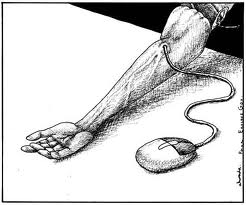
We all love our internet connections and mobile phones and would find it extremely difficult to live without them. However, addictions are still addictions, and there is no doubt that our children have grown a deep addiction to the internet. So bad is the problem, that children have become more addicted to the internet than to TV:
Just 18% of children would miss TV most, compared to mobile (28%) and Internet (25%), finds Ofcom research
A new research by communications watchdog Ofcom has revealed that more young British teenagers can do without TV but not without mobile and the Internet.
Ofcom research found that just 18% of children aged 12 to 15 would miss TV most, compared to mobile (28%) and the Internet (25%). However, the research suggests that the teenagers are also watching more TV than ever before, with viewing figures increasing by 2 hours since 2007.
In 2010, children aged 4-15 watched an average of 17 hours and 34 minutes of TV per week, compared with 15 hours and 37 minutes in 2007. Nearly one third (31%) of children aged 5-15 who use the Internet are watching TV via an online catch-up service such as the BBC iPlayer or ITV Player, said Ofcom.
Ofcom’s research said that 95% of 12-15 year olds now have Internet access at home through a PC or laptop, up from 89% in 2010 and 77% in 2007.
Social networking is still one of the most popular uses of the Internet amongst 12-15s. Ofcom said that children are visiting social network sites more often on their mobiles. Half (50%) of 12-15s with a smartphone visit them weekly compared with 33% in 2010.
Children aged between 8-11 are more likely to use Internet for gaming, with 51% saying they play games online on a weekly basis, up from 44% in 2010. 8-11s are also spending more time playing on games players/ consoles compared with 2010 (9 hours 48 minutes – an increase of nearly 2 hours), said Ofcom.
In my school days television addiction was a problem. Now we have another addiction which comes with the same side-effects. It creates tired students who have been up so late they can’t concentrate. It has compromised our children’s capacity to have healthy social interaction. Playing with a friend has now become messaging a friend. It’s just not the same.
As soon as people go from the moderate to the obsessive, they lose control of themselves. Children today are certainly showing the signs of a lack of control, to the point where they are smuggling mobiles in their bags so they can reply to Facebook messages as soon as they receive them.
Kids require rules for their internet usage. Rules that outline when, how and where they can use it.
Unfortunately, teachers and Facebook aren’t always a match made in heaven. Whilst the vast majority of teachers on Facebook are responsible and mature enough to stay out of trouble, there’s always a news story popping up about tasteless comments a teacher made against students or minority groups. This month it is Viki Knox, a Special Education teacher who was rightly condemned for her anti-gay comments on Facebook.
The media storm resulting from the Knox case and others like it serve as a timely reminder to teachers on Facebook that they must be extremely careful not to offend (something which shouldn’t be hard to do).
More than one in seven teachers has been the victim of cyberbullying by pupils or parents, and almost half know a colleague who has been targeted, according to a survey published today.
Students have set up “hate” groups on social networking sites calling for specific teachers to be sacked and have even created fake profiles in their names containing defamatory information.
Schools must make clear to pupils that such behaviour will lead to punishment, the Association of Teachers and Lecturers (ATL) said.
Schools seem to be increasingly soft on parents that bully teachers. Turning a blind-eye to Facebook campaigns and insulting comments against teachers is not acceptable. Teachers so often feel isolated and powerless against taunts from parents.
Who do they turn to for support?
When schools claim to have a “zero tolerance for bullying”, they ought to include bullying of teachers by parents. Any parent caught bullying a teacher online should be subjected to the same penalty as a teacher. They should be told to take their child and find another school.
If you think that’s harsh, try being a bullied teacher. I’m glad I’ve never been bullied, because I guarantee you, it’s not easy!
Today, my blog Topical Teaching, celebrates its very first birthday.
In the past 12 months I have witnessed probably the most difficult period for teachers in recent memory. From layoffs, to debates over tenure vs skilled teachers, it has been a period of great uncertainty. Teachers are facing great negativity by those that are looking for an easy target to blame.
Whilst there are a premium of poor teachers out there, there are also brilliant teachers in great supply. Teachers are not to blame for the state of our education system. There are other stakeholders that must lift their game as well.
In the past year the Facebook phenomenon has uncovered a potential danger for teachers. It is clear that teachers on Facebook must be extra careful to avoid controversy, as some have made very poor judgement calls that have cost them dearly in the end.
Teachers are also faced with an ever-growing bullying problem. From the classroom to cyberbullying, teachers have the important task of limiting incidences of bullying as best they can.
The rigours of standardised testing has also been a hot topic throughout the year. From cheating scandals to stressed out teachers the blasted tests are here to stay and the question is, are our students better for it?
Thank you to those of you who clicked on and contributed to my blog. I have really enjoyed sharing ideas and interacting with you. A special thank you to regular contributors, Margaret, Carl and Anthony for their loyalty and insight.
I hope, as I continue writing this blog, teachers get the break they so richly deserve. Teaching is a profession that attracts people who want to make a difference. We aren’t in it for the money or prestige, just the opportunity to help the students of today become the role models of tomorrow.
I read a brilliant article in The National about the lies we tell our children and when is the right time to confess that the Easter Bunny they are so fond of isn’t real.
Below is just an excerpt of the article. I strongly encourage you to read the entire piece by following this link.
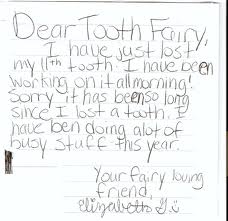
The world is a confusing place for small children, particularly as they only learn to distinguish between reality and fantasy between the ages of three and five. Jacqueline Woolley, a psychology professor at the University of Texas in the US, found that by the age of four, children learn to use the context in which new information is presented to distinguish between fact and fiction. So, before long, your little one will be figuring out that the tooth fairy isn’t who you said she is. Which begs the question: at what age should we tell our children that their beloved magical characters aren’t real? Or, should we even claim that they’re real in the first place?
Last Christmas I witnessed the most heated debate I’d ever come across on Facebook. It didn’t involve politics, religion or money. No; it was Santa Claus who caused the divide. One friend posed the question: “Should I tell Sophie Father Christmas is real?” What followed was a polarised debate between those who wanted their children to enjoy a magical gift-giving time and those who believed that perpetuating the story of Santa was being dishonest with their offspring. “I was devastated when I found out it was my mum, not Santa, who hung the stocking on the end of my bed,” admitted one father. Whereas others regretted never having the chance to believe in Santa because older siblings had spoilt it for them.
“I make a point of always being honest with my daughter and now she has turned six I’m feeling increasingly uncomfortable with perpetuating the lie of Santa Claus,” admitted Rosie Cuffley, a mother of two.
According to Carmen Benton, a parenting educator and educational consultant at LifeWorks, Dubai, Rosie shouldn’t worry. “Sharing the world of fantasy characters with our children is not a lie, but rather a playful way of storytelling and connecting as a family to fun events. Think about the joy and excitement that thoughts of characters such as Santa Claus can induce. You have the power to create a magical world of dreams, wishes and storytelling for your kids and I believe these are part of being a playful parent.”
It’s a different scenario when children ask directly whether Santa Claus, for example, is real. Most psychologists agree that children need to know they can trust their parents to tell them the truth, even about magical characters. “The majority of children will let go of a fantasy after the age of eight, and most would be happy for the years of the imaginary world they had been able to enjoy,” says Benton.
I feel terrible that my daughter still believes in the Tooth Fairy. I don’t like perpetuating a lie (especially one I know will be uncovered sometime soon). I have a feeling, irrational or otherwise, that when she does find out, her first thought will be, “What else is he lying to me about?”
At present schools have been able to turn a blind-eye to cyberbullying. As the offence occurs out of school hours, schools have been only too happy to handball the problem to the parents of the bully. Whilst I believe that parents are ultimately responsible for the actions of their children, I ask that schools do more to help deal with this ongoing problem.
The reason why I feel schools should involve themselves more actively with this issue is that most cases result from pre-existing schoolyard bullying. Having started in the playground and classroom, the bullying then gets transferred online. Whilst the school isn’t liable for what goes on after school, the problem is often a result of what started during school hours.
To me, the best schools are the ones that work with the parents in a partnership for the wellbeing of their students. For a school to excel it needs to show that it cares about its students beyond its working hours. That is why a teacher or staff member that is aware of cyberbullying must be able to do more than discuss the issue with the class. They must be able to contact parents, impose sanctions and actively change the situation at hand.
We also have to understand what cyberbullying is and why kids do it.
Suicides from cyberbullying are extreme cases that draw attention. Media and government attention are creating a panic around the wrong issue. The issue isn’t so much that a child killed himself because he was cyberbullied. He did it because he was subjected to hate crime — harassment based on sexual preference, race and the like — couldn’t get it to stop, and felt hopeless, eventually leading to suicide. Thus, the attention needs to go to the source. How do you teach young people to be kind, open, or at the very least accepting of kids different from them?
If we are to ever put a stop to bullying — wherever and however it takes place — we must step back for a moment and think of what we have done for many years before “cyber” became an indelible part of our language.
I am reminded of this lesson my father taught my brothers and me as we were growing up. Like many kids do, we would say we “hated” something or someone. Perhaps it was a certain food or a person in our school. My father always reminded us not to hate by not allowing us to use the word “hate.” We could simply express our feelings by talking about what we didn’t like about a thing or agree with about a person.
As we adopted this house rule, we found ourselves talking about things and people we liked more than the things and people we didn’t like. Today I find myself sharing the same lesson with my own children. I am hearing them talk about things they like about a person or thing without mentioning hate. The lessons that strengthen tolerance begin in the home, “cyber”-connected or not.
It is my belief that cyber-bullying is often based on “dominance” and “popularity” rather than “hate”. I don’t think most cyberbullies hate their victims. Instead, I think they see them as stepping-stones to wider acceptance from their peer group. Often the victims are minorities or outcasts. The pressure to be in the “in group” has always been high. For an “in group” to exist there needs to be a clearly defined “out group”. It is often seen as a sort of right of passage for someone seeking popularity to kick the easy target.
If my theory is right, there is even more reason for schools to see cyberbullying as a problem that they have a significant share in.
The message to parents has been clear: Monitor your child’s Facebook page to ensure that they maintain their page in a safe and responsible way. But there are parents who think they are doing a meticulous job of supervising their children, only to come undone by a loophole being heavily exploited to ward off protective parents:
Are you a parent who keeps an eye on who posts what on your child’s Facebook account? Perhaps you know their password and sneak a look at their messages from time to time? You may even enjoy the trusted privilege of being a “friend”.
Whatever the situation, social networking sites are a source of anxiety for parents, and now the latest trend will only add to their alarm. Children are staying way ahead of attempts by parents and schools to police their online activity And the latest ruse is a secret, fake-name Facebook account.
“Some kids will have two or even three,” says Dr Barbie Clarke, of the youth research agency Family Kids and Youth, who monitors online trends among schoolchildren in the UK.
“Their habits change and we’re seeing them progress from the obvious lie about their age – allowing them to use Facebook in the first place – to this second or third identity. It’s usually driven by Mum picking up on something from their page and raising it with them. They want privacy and they want a secret world.” She is very relaxed about Facebook use by children, saying she thinks they are generally more sensible and supportive of each other than they get credit for. “A second identity can be used for nastiness, to anonymously bully, but generally it’s about secrecy – like a secret diary, or dialogue they can have away from parents and other family members.”
Many children use school facilities to access their fake accounts. “I have two,” admits Harriet, 14.
I feel sorry for today’s parents. With new and highly specialised technological advances flooding the market, parents are finding it much harder to adapt than their children. No matter how hard they try to supervise and protect their children, sometimes it must feel like hitting your head against a brick wall.
I used to be philosophically opposed to homework in all forms. That was, until I witnessed how my students used their after-school time. It was then, that I realised that ten to fifteen minutes a night would constitute the only meaningful activity some of these students would take part in on a given night.
The radio presenter Alan Jones doesn’t believe in homework because children should have time to play outside and learn skills that only time after school with your family can teach. Normally, I would agree. But do children today have these types of experiences after school?
Families are so busy working that when children come home, they often sit in front of the TV for hours or play computer games. Children spend hours every day networking on Facebook. Exhausted parents do not realise just how dangerous these modern technological tools can be.
Technology can open a world of excitement to children. Yet it can also glorify gangster lifestyles through MTV, and encourage the use of bad language and ”text speak” in social networking.
An hour of homework a night distracts children from such activities and enables them to practise what they were taught at school. Excellent learning requires constant revisiting, and homework is the perfect tool to reinforce facts and skills. Teachers often find that children forget what they learnt the day before. At high school, you may not see your history or geography teacher for a few days until the next lesson. Without any homework in between to bridge the gap, often teachers take two steps forward, then one step back in the following lesson.
It is the school’s responsibility to inform parents that homework has been set – easily done through a diary system. The school should also ensure the homework set is of quality and not some assignment that can essentially be downloaded from the internet. Equally, it is the parents’ responsibility to ensure homework gets done.
I object to her call for an hour of homework per day, but I do currently favour 10-15 minutes of revision work, to consolidate on skills and concepts currently being covered in class.
Well, I have taught math in the past. My thoughts on homework was that if students had homework, they didn’t get finished in class. I never assigned homework. Homework was there if they didn’t get finished in class, but most times students did.
Now that I teach Science, it’s the same way. A lot of what we do is in class, hands-on activities. Homework are the questions they didn’t get to because they were goofing off or not focused in class.
In my opinion, teachers who teach the entire period and allow no work time are not good teachers. Students need to know they are being successful and have confidence. They can’t have a teacher telling them they are correct when they are at home.
This topic remains a very contentious one. I look forward to reading your opinions on this much discussed issue.
I can understand how a parent can feel frustrated and powerless when they find that their child is bullied at school. I am not surprised to hear that many schools are slow to act on bullying (if at all). Schools should not hide behind draconian policies and soft and ineffective consequences and should start taking real affirmative action with bullying behaviour.
But it is not the place for a parent to confront the bully, instruct their child to beat up the bully and most of all it is not a parents place to strike their child’s bullies. Daphne Melin might have tried to help her daughter ward off bullies, but in doing so she exposed herself as the real bully in this sad and sorry episode:
Cell phone cameras recorded Daphne Melin egging on her 12-year-old daughter, as she fought with another girl.
And then, the 32-year-old mother lashed out at a third preteen, grabbing her by the hair and kneeing her at least twice in the face.
“I don’t encourage fighting, I think it’s the wrong thing to do,” Melin told Eyewitness News on Tuesday night.
She blamed the William Floyd School District, insisting her daughter had been the victim of bullying and threats of physical violence online, actions she claims administrators did nothing to stop.
So at her wits end, Melin’s lawyer Michael Brown says she drove her daughter to the schoolyard to confront her tormenters.
“You get very frustrated with a couple of things. The lack of response by the authorities coupled with the fact that your daughter, who is an innocent person, is being continuously harassed,” she said.
Whilst I feel that this should be a lesson to all schools that are not doing enough to address their bullying problems, the biggest lessons of all are reserved for parents. Not even the frustration of an inactive and non-compliant school warrants such behaviour. Ms. Melin should have known better. Her conduct, especially in relation to a concerned bystander was just appalling.
Parents are clearly worried about their children’s online activities. They are worried about the content they get access to and the people they befriend and chat with on social media sites such as Facebook.
In a nationwide survey conducted by legal information website FindLaw.com, it was revealed that 67 percent of 627 parents are extremely worried (10%), very worried (18%) or somewhat worried (39%) about their children’s safety online. About 20% said that they are not very worried while 14% are not worried at all. The study was done with a small sampling but FindLaw.com said that it was demographically representative.
Most parents are taking steps to restrict their children’s use of the Internet. Steps taken vary, including: monitoring which sites they visit (35%); using site-blocking software (21%); restricting their access to computers (19%); restricting the use of social networks (18%); reading their emails or social posts (17%); and not allowing any Internet use (8%).
I recently attended a Professional Development session on cyber culture. The survey conducted by AISV interviewed thousands of kids from Grade 4 to Year 8 and collected information about their internet habits. Some of the interesting findings included:
1 in 5 year 5/6′s don’t consult parents about their internet activity.
15% of year 5′s and 20% of year 6′s have internet access in their bedrooms.
Half the respondents claim they don’t have parent imposed internet rules.
30% of respondents know ways in which to circumvent parental controls such as bypassing net filters and minimising pages when parents approach.
40% of respondents name their school or city on social media sites such as Facebook.
84% use chat rooms on a daily basis.
Approx. 3/4 don’t use privacy function on their social media pages.
I have 2 tips for parents to help keep their children safe.
1. Don’t allow them to have a computer (or move the i-Pad or notebook) in their bedroom. Instead keep the computer in the living room or another room that is open to you and other adults.
2. Please watch the clip below with your children. It is a brilliant clip about cybersafety. I have posted it before and will continue to do so when discussing this issue.
I don’t understand why parents can’t be subject to the kinds of consequences their children are for bullying and harassment. Parents who set up internet groups and Facebook pages to spread untruths about their childs’ teacher should be punished for their actions. Anything from a warning to in the most serious offences expulsion of their child from school is appropriate.
Some may think this is a bit harsh and that children should not be penalised for the deeds of their parents, but bullying is a very serious offence and schools that take it seriously reap the rewards by maintaining a safe environment. Schools are too dismissive of parents who bully teachers. Teachers often feel marginalised and lacking of support. The statement that bullying of any kind will result in strong penalties is essential to delivering the best outcomes from an academic and social standpoint.
Teachers are the latest group found to be at risk of cyber-bullying, according to a recent report.
The study by Professor Andy Phippen found several instances where teachers had been targeted for abuse by social media users on websites such as Facebook and Twitter.
One head teacher interviewed for the study said she had a breakdown and was left feeling suicidal.
The headteacher suffered a year of abuse by a parent at her school who used a Google group to post libellous untruths about her and her school. “I eventually had a mini breakdown in the summer holiday, needing an emergency doctor to be called out as I had become suicidal,” she told researchers.
The message should ring loud and clear – Either play by our rules or find somewhere else to send your kids!














 Topical Teaching