Posts Tagged ‘England’

British Children ‘Unhappiest in the World’

June 27, 2012

Academics claim that British children are unhappier than children from any other country. I’d be interested to know what their definition of “happy” is:

Growing numbers of children are failing to develop properly at a young age because of the toxic pressures of modern life, it was claimed.

The powerful lobby of childcare experts said that many “commercially vulnerable” under-16s were spending too much time sat unsupervised in front of televisions, games consoles and the internet in their bedroom instead of playing outdoors.

Children are also among the most tested in the Western world after being pushed into formal schooling at an increasingly young age and more likely to be exposed to junk food and poor diets than elsewhere, they said.

The comments were made as a new group – the Save Childhood Movement – was launched today in bid to highlight the multiple threats facing young people.

School Calls Police to Stop A-Grade Student From Studying

June 21, 2012

Since when do we call an ambitious, conscientious and hardworking student a “nuisance”?

A BRITISH high school called police to remove a star pupil who refused to stop studying and leave the library.

Jamie Gagliardi, 18, was ejected from Ifield Community College in southern England, after refusing to leave the library, the Crawley News reported.

The school accused Mr Gagliardi, who is predicted to be an A-grade student, of being “obsessed” with after-school tuition and said that it called the police because the pupil was causing a “nuisance.”

Mr Gagliardi, who was forced to call his mother to pick him up, said, “I have been punished for wanting to do well. I am a hard-working and dedicated student, and this could have such an impact on my future.”

The student went to the library despite being banned from the premises for the day as a punishment for interrupting the school principal during a meeting – to request extra revision sessions.

Marilyn Evans, the school’s director of administration, said, “He became vociferous and irritated that he couldn’t have after-school revision.”

She described Mr Gagliardi as a “top student” who should do well in his exams, but said he had been “causing a nuisance and a disturbance on the premises,” adding, “He is obsessed with doing after-school revision.”

A police spokeswoman confirmed that officers were called to the school to remove a “disruptive” pupil who was refusing to leave the premises, but said that Mr Gagliardi will not face any charges.

This case sends the wrong message for the school’s other students. Most schools would take that form of “disruptive student” over the ones they currently have.

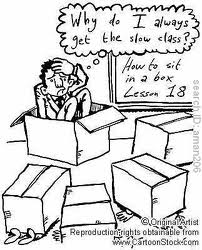
The System Fails Slow Starting Students

December 15, 2011

As a child who started slow and only came into my own after school, I have always been determined to help slow starting students find their feet as quickly as possible. It is my belief that the classroom teachers can turn the fortunes of a slow starting student around.

This belief however, is not supported by the data:

Three-quarters of children in England who make a slow start in the “Three Rs” at primary school fail to catch up by the time they leave, data shows.

And more than a third (39%) of pupils who make a bright start are no longer reaching advanced levels when they leave.

The government’s school league tables data also shows 9% of primary schools do not meet its floor standards.

Overall 74% of pupils met the required levels in English and maths.

Some of those kids that are allowed to fall through the cracks are victims of poor teaching. Often the slow start comes about because the learning style of the student differs to the way the information is conveyed by the teacher.

I think it’s a major cop-out to let the slow starters continue on their merry way without giving them the intervention they so desperately need.

It’s Time That Teachers Get Trained Properly

September 28, 2011

It’s just bewildering how unprepared our system seems to be in dealing with students who turn up to school without basic language skill.

When a person fronts up to a doctor with an ailment that came about from unhealthy eating habits and reckless behaviour, the doctor doesn’t throw his/her hands up in the air and tell them that they can’t properly help them because of their inability to look after themselves.

When a plumber gets called to a house to inspect a toilet that has been clogged due to the owners stupidity and laziness the plumber doesn’t refuse to take the job citing that they can’t fix a problem that wouldn’t have existed had the owner stuck to flushing toilet paper only.

There are professionals that are prepared to take on all kinds of cases regardless of the negligence or challenges involved.  And then there’s teachers …

Traditionally, teachers seem to crumble when presented with students who haven’t acquired basic skills at home.  I am glad to hear that our wonderful profession is taking more positive steps in dealing with this problem:

In socially deprived areas more than 50% of children begin school without the ability to speak in long sentences, which experts say can lead to problems in later life. Schools across England are taking part in a day without pens to tackle this speech deficit.

It took the whole class of five and six-year-olds six attempts to reassemble these jumbled words into a coherent sentence: “Past the walked we shops.”

Partly it was the noise in the classroom which made listening difficult.

Partly it was the distracting presence of a man from the BBC with a microphone.

But mostly it was unfamiliarity with the basic rules of English, their first language, which made the exercise so long winded.

The children, from Baguley Hall Primary School in Wythenshawe, south Manchester, are bright and normal children.

But they have had few opportunities to develop conversation skills.

It is a poor area with high unemployment and a large proportion of children living in lone parent households.

 Family discussions do not happen very often.
Of course I am making a generalisation  (and I am not comparing a child with a clogged toilet!). There are plenty of teachers fully equipped at dealing with this issue.  But there are too many that aren’t.
For me this has little to do with effective teaching and more to do with effective teacher training.  Teachers are not fully prepared for the child that doesn’t know how to carry a conversation because practical skills aren’t properly covered in a Teaching degree.
Whilst it would be nice for parents to ensure their children turn up to school with basic language skills this just can’t be relied upon.  Teachers need to be prepared for all types of scenarios.
Unfortunately, they are not prepared at all!