Posts Tagged ‘Engaging Students’

50 Ways To Use Skype In Your Classroom

September 17, 2012

Courtesy of edudemic.com. Below is the first 17 suggestions:

  1. Meet with other classrooms:
    One of the most common projects educators utilize Skype for is setting up exchanges with classrooms around the world, usually for cultural exchange purposes or working together on a common assignment. The program’s official site provides some great opportunities to meet up with like-minded teachers and students sharing the same goals.
  2. Practice a foreign language:
    Connect with individual learners or classrooms hailing from a different native tongue can use a Skype collaboration to sharpen grammar and pronunciation skills through conversation.
  3. Peace One Day:
    Far beyond classroom collaborations, the Peace One Day initiative teamed up with Skype itself and educators across the globe to teach kids about the importance of ending violence, war, and other social ills.
  4. Around the World with 80 Schools:
    This challenge asks participating schools to hook up with 80 worldwide and report back what all they’ve learned about other cultures and languages.
  5. Talk about the weather:
    One popular Skype project sees participants from different regions make note of the weather patterns for a specified period of time, with students comparing and contrasting the results.
  6. Collaborative poetry:
    In this assignment, connected classrooms pen poetic pieces together and share them via video conferencing.
  7. Practice interviews:
    The education system frequently receives criticism for its failure to prepare students for the real world, but using Skype to help them run through mock-up interviews with each other, teachers, counselors, or professionals will help grant them an advantage.
  8. Gaming:
    Merge the educational power of gaming with the connectivity of Skype for interactive (maybe even international!) role-playing and other competitive delights that educate and engage in equal measure.
  9. Hold a contest:
    Challenge other classrooms to a competition circling around any subject or skill imaginable, and work out a suitable prize ahead of time.
  10. Hold a debate:
    Similarly, Skype can also be used as a great forum for hosting formal and informal debates to help students with their critical thinking and research skills.
  11. Make beautiful music together:
    Build a band comprised of musicians worldwide, who play and practice together over video — maybe even hold digital performances, too!
  12. Who are the people in your neighborhood?:
    All the press about classrooms meeting with one another tend to veer towards the international, but some schools like to stay local. These two Tampa Bay-area kindergartens met regularly via Skype, sharing their current assignments with new friends only 10 miles away.
  13. Highlight time differences:
    But there is something to be said about global exchanges, too, as it provides some insight into the differences between time zones — great for geography classes!
  14. Combine with augmented reality:
    Both at home and in school, Skype provides a communication tool for collaborative augmented reality projects using the PSP and other devices.
  15. Mystery call:
    Link up to a classroom in another region and have them offer up hints as to their true location, challenging students to guess where in the world their new friends live.
  16. Each student works a specific job during calls:
    Divvy up responsibilities during Skype calls so every student feels engaged with the conversation, not just passive participants watching talks pan out. Assign bloggers, recorders, mappers, and any other tasks relevant to the meeting and project.
  17. Play Battleship:
    The classic board game Battleship offers up lessons in basic X and Y axes; plus it’s also a lot of fun. Compete against other classrooms for an educational good time.

Click here to read the rest.

Click on the link to read Top 10 Educational i-Pad Apps

Click on the link to read Top 10 Math Apps for Children

Click on the link to read The Pros and Cons of iPads in the Classroom
Strategies for Improving Classroom Interactions

September 16, 2012


Courtesy of facultyfocus.com:

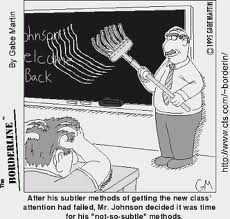
Make the class interactive: Do everything possible to transform the students from passive observers to active learners. Get the students out of their seats frequently to work in twos or threes on analyzing an issue. Students learn more and retain more when they are actively involved. Working in pairs at the start of every class gets everyone engaged, not just the people who raise their hands. Plus, then students share their thoughts with each other first, the class discussion will be of a higher quality.

Call on students constantly to answer questions: Make a habit of calling on individual students by name to answer questions without first asking for volunteers. This keeps the whole class awake and alert. Never go for more than three or four minutes without getting one of the students to speak. You want your students to be on their toes, knowing that you might call on them at any time to answer a question.

Reassure students you will come back to them: If two or more students raise their hands at the same time, reassure those not selected that you won’t forget to come back to them for their questions in a moment.

Find a student’s strength: If one student is particularly adept at a particular skill set, point it out and have an expectation for the student to be the “expert.” This raises the student in the esteem of classmates and encourages the student to stay abreast of the topic. Try to find a dozen students like this in your class for a variety of topics by being specific in your praise. Don’t just say, “That was a well-written paper,” but indicate exactly what about the ideas, or wording, or structure of the paper you felt made it stand out.

Encourage shy students to speak:Protect the soft-spoken and encourage shy students to speak. Don’t allow long-winded or loud students to dominate the classroom discussion. Call on those who don’t speak much so everyone is heard from. I had one student who was shy and hated to come to the front of the class to talk. At the same time, she was an excellent student and wanted to overcome her fear of public speaking. I worked out a plan with her to allow her, for the first few times, to present from her seat instead of coming to the front of the class. This helped and she made great progress talking in class. Another idea is to pose a question and give the students a few moments — this allows students to formulate their thoughts before the discussion begins [McKeachie 34].

Listen actively to students during discussions: During discussions, maintain strong eye contact with the student speaking so he/she has your complete attention. Students want to be heard. By nodding, smiling or otherwise acknowledging the student, you show that you are totally committed to listening and understanding what each student has to say. Give critical feedback, but look for ways to compliment the student for the observations so the student feels encouraged. Guide class discussions so they don’t wander too far off-mission.

Incorporate peer review: When students make presentations, which they should do frequently, encourage peer review. Get students to teach each other and to learn from each other. It engages them more than the professor doing a solo act.

Do a networking exercise: In some of the early classes in the semester, give students a three-minute “networking” exercise. Before it starts, stress the importance of networking (making contacts and meeting key people) to their careers. Then tell them to stand up, move around the room and find a student they don’t know or know very little. Give them an exercise (such as a question relevant to the class or finding out something unique about the person) and then have them report back to the whole class on what they learned from each other.

Ask early for feedback from students: One month into the class (about the 4th or 5th class) ask for feedback. Three possible questions to ask are: What is helping you learn in this class? What is getting in the way of your learning? What are your suggestions for the rest of the semester? Give them a leisurely ten minutes of silence to write their answers. Tell them they are welcome to hand the answers anonymously if they’d prefer. Repeat this exercise about two months into the class. It will give you valuable information about what is and is not working, allowing you to change, modify or tweak what you are doing.

Always report back to the class on what you learned from the feedback and the changes you intend to make as a result. Make it clear that you welcome candid and constructive feedback from students and make sure you implement the changes you promise to make. This exercise will empower your students and send the message that you care about how they are doing in the course, and that you are open to making changes for their benefit.

Click on the link to read The Ultimate Classroom Resource for Teaching About Comics

Click on the link to read Why Spelling is Important

Click on the link to read Tips for Engaging the Struggling Learner

Click on the link to read the Phonics debate.

Tips for Engaging the Struggling Learner

September 12, 2012

Courtesy of Andrew Marcinek comes this fabulous list:

1. Have fun

I hope that this project will make writing a paper a more engaging process. Many times, students go through the motions in pursuit of the grade while missing out on the learning. This is where I hope this project will take us in a different direction. Too many times in higher education grades are obtained and learning is left behind. This is where that routine changes. I want you to become an expert on the issue you are covering and enjoy the process of research and writing.

2. Learn beyond the walls

Every week we enter our classroom and shut the door. There are no windows, one computer, and eight outlets. However, most of you possess devices that connect you to the outside world and to numerous contacts. Some of you are probably reading this on a mobile device. What is wrong with this picture? It is a skewed vision of what learning should be. Therefore, this project will take our class beyond the walls and windowless concrete and carry us into a world that is constantly connected and moving.

3. Expand your audience

I read your paper. I edit your paper. I grade your paper. Yawn. While I am an objective, worthy audience, I am simply one person. Today’s student has the ability to reach out to millions on a daily basis and simply ask, “Is this good?” This project will present many windows to your work and engage you in a learning community beyond the walls of the Science Center. Learning should be transparent and open. Please allow others to collaborate with you as we engage in a new learning community.

4. Collaborate

One of our best resources as learners is our ability to connect. We can connect like never before and have the opportunity to engage with others from around the world on a daily basis. If we can learn anything from the web 2.0 generation it is that the ability to share and learn from each other is limitless.

5. Deconstruct an issue transparently

This project will open up your research and allow others to see how you are progressing. This project will model an environment of constructive criticism and intellectual discourse. There is no room for bullying or inappropriate criticism. This environment will employ transparency so that we can share and learn from each other.

6. Make many mistakes along the way

Unlike traditional assignments where mistakes are marked wrong, this project will mark your mistakes as learning steps. I encourage you to take risks and seek out information beyond what you think may or may not be right. In this forum, being right is hardly the end goal. Rather, the pursuit of greater understanding while exercising all of your options within a moral and ethical framework.

7. Share

What happens when you take notes within a notebook? You eventually close that notebook and put it into a bag, or drawer. Only you possess that information. This is hardly the way our world works today and hardly the way we will conduct our research for this project. By conducting research that is transparent, it will allow us to use a variety of sources and learn from each other.

8. Provide Constructive Criticism

One of the benefits of transparent learning is the ability to not only receive feedback from the instructor but to seek feedback from a much larger audience. This community we are creating will allow us to bounce ideas and critique work as we progress. While I will also take part in this critique, I urge you to consult your classmates for feedback and suggestions.

9. Eat a sandwich

A sandwich is like a well-constructed argumentative essay. It contains many layers but is constructed in a central…Ok, I can’t continue with this nonsense. Just make a sandwich and enjoy it.

10. Engage Others

This type of work will require you to engage an audience and be a participatory learner. It is hard to sit back and coast in this format and will require each student to be an active participant in the learning process. I look forward to learning from each of you and creating a community of resources.

Click on the link to read The Ultimate Classroom Resource for Teaching About Comics

Click on the link to read Why Spelling is Important

Click on the link to read Captain Phonics to the Rescue!

Click on the link to read the Phonics debate.

Our Authors Don’t Want us Teaching Phonics

July 25, 2012

There is a major phonics debate going around. One side argues that one must learn phonics to be able to read properly, the other suggests that phonics is dry and boring and detracts from the pleasure of reading:

More than 90 of Britain’s best-known children’s authors and illustrators have called on the government to abandon its plans to introduce early-year reading tests, warning that they pose a threat to reading for pleasure in primary schools.

The former children’s laureate Michael Rosen is leading the writers’ charge against a phonics-intensive approach to teaching young children how to read.

A letter to the Guardian signed by 91 names including Meg Rosoff, Philip Ardagh and Alan Gibbons says millions is being spent on “systematic synthetic phonics programmes” even though there is “no evidence that such programmes help children understand what they are reading”.

Rosen told the Guardian: “It does not produce reading for understanding, it produces people who can read phonically.”

Click on the link to read Who Said Grammar Isn’t Important?

Click on the link to read The Resistance Against Teaching Grammar

Click on the link to read Captain Phonics to the Rescue!

Click on the link to read the Phonics debate.

Adults Look Like Fools When they Take a Kids Survey Seriously

July 10, 2012

Never, ever take a kids survey on face value!

According to a recent survey millions of children are complaining that school is too easy.

My students often boast about the lesson content being very easy. Then I assess them. It often turns out it wasn’t as easy as they first thought.

Why on earth would we believe a kids survey that claims school is too easy when it isn’t backed up by assessment results?

Millions of kids simply don’t find school very challenging, a new analysis of federal survey data suggests. The report could spark a debate about whether new academic standards being piloted nationwide might make a difference.

The findings, out today from the Center for American Progress, a Washington think tank that champions “progressive ideas,” analyze three years of questionnaires from the Department of Education’s National Assessment of Educational Progress, a national test given each year.

Among the findings:

•37% of fourth-graders say their math work is “often” or “always” too easy;

•57% of eighth-graders say their history work is “often” or “always” too easy;

•39% of 12th-graders say they rarely write about what they read in class.

If I was from the Center of American Progress I would be embarrassed to admit to spending so long on a survey that is clearly misleading. Talk about a waste of three years!

Rule 1: Never ask students whether class work is easy when you can get a better picture by gauging their assessment results (I’m not referring to standardised tests).

Rule 2: Never ask students whether their homework was easy. Instead, ask their parents as they are the ones that do it.

Rule 3: If you are trying to make education more “progressive”, don’t waste three years on a survey.

Click here for a more in-depth analysis of this survey.

Teaching Fractions: The Musical

March 22, 2012

As it is very difficult to convey the skills of fractions,  I am keen to see how a new programme that helps students learn fractions to music actually works. Fractions is often the skill that teachers dread to cover. I have heard of teachers that have demanded to teach lower grades just to avoid it.

That is why I am sure that this programme will generate plenty of interest:

For tapping out a beat may help children learn difficult fraction concepts, according to new findings due to be published in the journal Educational Studies in Mathematics.

An innovative curriculum uses rhythm to teach fractions at a California school where students in a music-based programme scored significantly higher on math tests than their peers who received regular instruction.

“Academic Music” is a hands-on curriculum that uses music notation, clapping, drumming and chanting to introduce third-grade students to fractions.

The programme, co-designed by San Francisco State University researchers, addresses one of the most difficult – and important – topics in the elementary mathematics curriculum.

“If students don’t understand fractions early on, they often struggle with algebra and mathematical reasoning later in their schooling,” said Susan Courey, assistant professor of special education at San Francisco State University.

“We have designed a method that uses gestures and symbols to help children understand parts of a whole and learn the academic language of math.”

It will be interesting to see if this programme becomes a success.

Six Tips For a Happy Classroom

January 6, 2012

These valuable tips come from Professor Dylan William, the inspiration behind the BBC2 series ‘The Classroom Experiment’.

* Stop students putting their hands up to ask questions – it’s the same ones doing it all the time. Instead introduce a random method of choosing which pupil answers the question, such as lollipop sticks, and thus engage the whole class.

* Use traffic-light cups in order to assess quickly and easily how much your students understand your lesson. If several desks are displaying a red cup, gather all those students around to help them at the same time.

* Mini-whiteboards, on which the whole class simultaneously writes down the answer to a question, are a quick way of gauging whether the class as a whole is getting your lesson. This method also satisfies the high-achievers who would normally stick their hands up.

* A short burst of physical exercise at the start of the school day will do wonders for students’ alertness and motivation. As any gym addict or jogger will tell you, it’s all about the chemicals released into the brain.

* Ditch the obsession with grades, so that pupils can concentrate instead on the comments that the teacher has written on written classwork.

* Allow students to assess the teachers’ teaching – they are the ones at the sharp end, after all. Letting pupils have a say is empowering and, if handled constructively, is highly enlightening.

I particularly like tip 5. We have become far too obsessed with grades. Comments from the teacher are a much better way of helping children achieve.

What ideas have you put into place that have improved the atmosphere of your classroom?

Schools Should Not Block YouTube

November 30, 2011

YouTube, in my opinion, is the hidden gem of education. It’s hidden, not because people don’t know it exists or what it can do.  On the contrary, everyone and their dog is aware of the diverse clips that YouTube contains.  It’s hidden because many schools, including until recently my own, have chosen to block it. The reason for this is fairly understandable – YouTube contains clips which are clearly unsuitable for children.

Whilst this is true, there is too much to be gained by exposing children to the wealth of educational opportunities that exist on YouTube to justify blocking it.

The other day I wanted to buy a phone.  I had a few in mind, but didn’t posses the technological nous to help me find something that would best give me value for money and fulfill my practical needs. So I did what many do when they can’t make their mind up about something – I asked YouTube.  On YouTube I watched clips on the various phones, was given a run through of their features, advantages, design and reliability issues etc.

This helped me settle on a phone.  But my education didn’t stop there.  As I am a visual learner, I require more than just a booklet to follow.  To set up my phone and navigate my way through the different functions I turned to my dear friend, YouTube, who again, didn’t let me down.

YouTube is the modern-day instructive tool. It clearly and carefully teaches people practical skills in language they can understand. It plays the part of teacher.

At the moment I am teaching my 5th Graders about finding the lowest common denominator before adding and subtracting fractions. As a test, before writing this blog post, I typed some key words into a YouTube search and came up with many fine online tutorials on this very skill that kids can readily access.  It shouldn’t replace the teacher, but it can certainly help a child pick up a concept.

And it’s not just academic skills that can be developed through YouTube.  If my school hadn’t relaxed its position on YouTube, I wouldn’t have had the chance to show my students the best anti-bullying film going around. I have come across so many lame and unconvincing films about bullying in my time. So to first find Mike Feurstein’s masterful film, and then get the chance to show the movie to my appreciative class, was a major coup for my ongoing efforts in trying to keep my classroom bully free.  The film, posted below is as good a reason as any to allow teachers to use YouTube in the classroom.

Sure teachers have to be on the lookout for students who may exploit this privilege, but ultimately that is our job. If we banned everything that has possible risks or negative outcomes, we wouldn’t have much to work with at all.


The Virtual Classroom: Life From Behind a Monitor

November 12, 2011

There will be many supporters of the concept of online classrooms.  People will see it as cheap, engaging and an opportunity for children who haven’t been able to acclimatise to the classroom to find a workable alternative.

But do we really want our children living through their computers?  Is real human interaction being permanently dismantled in favour of communication via the computer screen?

The online classroom takes the social media age a step further:

In a radical rethinking of what it means to go to school, states and districts nationwide are launching online public schools that let students from kindergarten to 12th grade take some—or all—of their classes from their bedrooms, living rooms and kitchens. Other states and districts are bringing students into brick-and-mortar schools for instruction that is largely computer-based and self-directed.

In just the past few months, Virginia has authorized 13 new online schools. Florida began requiring all public-high-school students to take at least one class online, partly to prepare them for college cybercourses. Idaho soon will require two. In Georgia, a new app lets high-school students take full course loads on their iPhones and BlackBerrys. Thirty states now let students take all of their courses online.

Nationwide, an estimated 250,000 students are enrolled in full-time virtual schools, up 40% in the last three years, according to Evergreen Education Group, a consulting firm that works with online schools. More than two million pupils take at least one class online, according to the International Association for K-12 Online Learning, a trade group.

It’s all part of a burst of experimentation in public education, fueled in part by mounting budgetary pressures, by parental dissatisfaction with their kids’ schools and by the failure of even top-performing students to keep up with their peers in other industrialized countries. In the nation’s largest cities, half of all high-school students will never graduate.

Advocates say that online schooling can save states money, offer curricula customized to each student and give parents more choice in education.

In my opinion, some of the biggest advantages of the conventional school system is that it provides children with the exposure to help, guidance, leadership opportunities, social interactions and a taste of the challenges that they will meet in the real world.

None of these advantages are addressed by a i-Pad.

Birbalsingh: Children Think Winston Chruchill is a TV Dog

October 7, 2011

Whilst I don’t agree with everything Katherine Birbalsingh preaches, I think it would be irresponsible not to listen and absorb her frustrations with what is a failing Education system.

She is right that you cannot have students busy doing activities all day without giving them some background knowledge.  But I think she is wrong to dismiss the issues raised from the traditional style of teaching which she espouses.  The “Boredom Factor” is a huge stumbling block when teaching kids.  One may have gotten away with endless rote learning and long mat sessions in my day, but the kids wont let you get away with it today.

Below are some of the views she raised in a recent speech:

In a major speech on Wednesday evening, she told of children who failed to understand that Paris was the capital of France and other pupils who believe Winston Churchill is “that dog off the insurance advert”.

“Teaching historical facts or lists of vocab which rely on memory skills is considered old-fashioned,” she said.

“Instead, we think it better to inspire children to be creative through group discussion and project work. But background knowledge is absolutely essential to enable children to absorb new ideas.”

“Teachers are not meant to stand in front of the class, but instead move amongst children who are all busy doing something. The idea here is that ‘doing’ is more interesting than ‘listening’.

“That might very well be true. But the problem comes when we think that ‘doing’ needs to happen most of the time.

“This means that the teacher, traditionally a source of knowledge, almost becomes redundant as a fountain of knowledge and instead, becomes something of a referee.”

“Ordinary people don’t realise just how little some of our kids know. What we also forget is that the very thing that got us to where we are now, was the kind of education that we had – our teachers teaching us knowledge, so that we know the difference between Paris and France, even if it sometimes meant being bored in lessons and learning the discipline to struggle through.

“How many people in business clinch a deal because they know the soft skills of being polite, or know how to sit through a boring lecture, and concentrate enough to still pick up what is necessary to impress the client?

“Soft skills cannot be taught in a vacuum, independent of content or knowledge.”

I don’t take in much at all from a boring lecture.  Why is it always a choice between two extreme philosophies (this time, the progressive and the traditional)?  Why can’t a teacher borrow from both approaches and teach in a way that suits the needs and learning styles of their class?  Why take on a boring style of teaching which may command basic concentration when you can take on a more engaging style and shoot much higher?

The problem with our system is more complicated than the shortcomings of a progressive style.  In part, the problem is a result of rigid and extreme philosophies, instead of a more flexible approach that can be tinkered with to suit the makeup of the teacher’s class.

That’s right – not all students are the same!  Therefore a teacher cannot afford to be a one-trick pony.  They have to adopt a style that can be tinkered with and amended all the time.