Posts Tagged ‘Education’

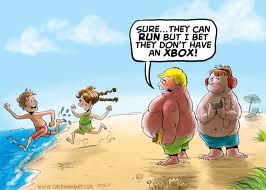
5 Ways to Get Kids Active

June 19, 2012


I heard a very surprising fact on the radio the other week. A nutritionist asked the listeners what they thought the leading cause of death was. Like most, I thought the answer was something like heart disease, obesity or cancer. It was none of the above. Apparently, the leading cause of death is inactivity.

That’s why it is so vital that we help our children to become more active. Here are some helpful hints by Steve Ettinger, a children’s fitness expert and author:

Be creative

Whether you live in an urban, suburban or rural environment, use the space, time and resources you have to find ways to exercise. For example, if you live in the city and don’t have access to outdoor space, find indoor activities. Ettinger also says if kids are sitting in front of the TV, challenge them to exercise in short spurts during commercials. It is a far better solution than having them get up to snack on junk food.

Schedule time to exercise

Writing down time to exercise makes it much more likely that you will do it. Even if it’s just playing at the park, schedule that time in your calendar.
Ettinger also says children who eat poorly will naturally not have as much energy and as high of an activity level as children who eat nutritiously.

Get involved as a family

One of the best ways to get children to exercise is for the family to participate together. Find something that everyone enjoys doing, such as bike riding or going for a walk around the neighborhood, and do it together. That way, there are fewer safety concerns because kids aren’t out by themselves, and everyone in the family – including yourself – gets to benefit from moving around.

Find something your kids enjoy

One reason kids stop exercising is that they are forced into activities they don’t enjoy. If your child doesn’t like a particular activity or organized sport, be patient and take the time to explore different options. Ettinger says if kids find activities fun, they will usually stick with them. He also says it’s best to find an activity for children before age 10 – otherwise, inertia will become a habit.

Educate yourself

Modeling proper nutrition and exercise is the best way to teach your kids about maintaining a proper weight and a healthy lifestyle. Ettinger says he is amazed by the number of parents who have misconceptions about proper nutrition. Seek out resources so you can learn the basics and incorporate these lessons into your own life.

Click on the link to read my post on 6 Strategies for Promoting Healthy Food to Kids.

Who Needs Quality Teaching or Parenting When You Have Medications?

June 19, 2012

Wake up America!  Your preparedness to prescribe powerful stimulants to children for reasons as slight as a lack of concentration is lamentable. It is a trend that threatens to effect a whole generation. Teachers have got to take a far more passive approach on this issue. Instead of recommending that students take these drugs they should instead concentrate on their own performance. Too many teachers take the selfish choice of trying to restrain a wayward or naughty child rather than focus on their own weaknesses as a teacher. Instead of picking on a childs’ lack of focus, they should be concerned about how engaging their lessons are.

To hear the medical fraternity boast about a reduction in antibiotics subscriptions when the real issue is Ritalin and others of its kind is very disappointing:

The new report also found an uptick in the use of some drugs in children, with stimulants for attention deficit hyperactivity disorder, or ADHD, leading the pack.

From 2002 to 2010, the use of ADHD drugs grew by 46 percent — or some 800,000 prescriptions a year. The top drug dispensed to adolescents was the stimulant methylphenidate, also known as Ritalin, with more than four million prescriptions filled in 2010.

“What the article is suggesting is that the number of children that we are treating for attention deficit disorder has gone up,” said Dr. Scott Benson, a child and adolescent psychiatrist and a spokesperson for the American Psychiatric Association.

“For the most part I think the overall increase reflects a reduction in the stigma,” he told Reuters Health. “It used to be, ‘You’re a bad parent if you can’t get your child to behave, and you’re a doubly bad parent if you put them on medicine.'”

Dr. Lawrence Diller, a behavioral pediatrician who has written extensively about ADHD, was more critical of the rise in stimulant prescriptions, noting that the U.S. is far ahead of other countries in its use of the drugs.

“You have to look at how our society handles school children’s problems. It’s clear that we rely much, much more on a pharmacological answer than other societies do,” Diller said. “The medicine is overprescribed primarily, but under-prescribed for certain inner-city groups of children.”

A report in the New York Times last Sunday said stimulant use is becoming a commonly used study drug even among high schoolers, with healthy students easily fooling their doctors into prescribing the coveted drugs.

“There is no objective test, so obtaining the medications is relatively easy,” said Diller.

“Better Pay Leads to Better teachers”: Prove it!

June 18, 2012

I believe that teachers deserve better pay. This shouldn’t surprise you as I am a teacher. But what I don’t agree with is the often used argument that if we paid teachers more we would attract a better standard of teacher. I have yet to have met a potential teacher who decided not to enter the profession based on the pay. I have also yet to have seen any difference to the quality of teachers after a pay increase.

A recent report finds that salary is a huge factor:

Several reports from the Australian government indicate that, although many high achievers consider teaching important and challenging, they do not pursue a career in teaching because salaries, promotional pathways and status are limited relative to other professions.

The research is clear that annual bonus pay schemes are ineffective in improving the quality of teaching or student outcomes or in making teaching a more attractive career.

There are some professions which attract based on promotional pathways and pay and others that attract based on the rewarding aspects of the job. I don’t want to teachers come in to the system based on pay and promotion reasons over passion and eagerness to make a difference.

Click here to read my post “If Teachers Were Paid More I Wouldn’t Have Become One.”

The Punishment That Used to Work but No Longer Does

June 18, 2012

When I was a child there was no punishment more feared than a suspension from school.  The idea that the Principal could at any moment call your parents to pick you up and take you home was enough to make any child think before breaking a rule. But times have changed and suspensions have lost their effectiveness. This is partly due to it being metered out for minor offenses such as answering back and rudeness and partly due to a change in parenting styles.

If my parents were given the call to pick me up early they would have been furious. They would have immediately sided with the school and grounded me at home. Nowadays, parents take their children’s side and embrace them rather than berate them. When the child returns to school after their suspension, it is common to hear them boast about being taken out for a coffee and spending the afternoon playing video games.

It is no wonder that a recent survey has labelled suspensions as ‘counterproductive’:

SUSPENDING students from school for bad behaviour is counterproductive, with students who have been suspended twice as likely to be excluded again in the next 12 months.

Research by Australian Catholic University professor Sheryl Hemphill found about 6 per cent of students in Years 6-8 have been suspended, rising to 12 per cent of Year 10 students.

“Kids who are suspended just keep getting suspended. It doesn’t stop the behaviour that resulted in the suspension, it almost sets them on a pathway more likely to lead to suspension,” she said. “The risk for students who are having trouble maintaining engagement and staying at school is that suspension starts to help them move out of school.”

As part of a series of reports on problems in our nation’s schools, The Australian has found that suspended students were 50 per cent more likely to engage in antisocial behaviour and 70 per cent more likely to commit a violent act in the next 12 months.

Professor Hemphill said the policy of excluding students from school as punishment for bad behaviour sent a mixed message: every child must attend school, except on some occasions.

“It’s so contradictory to everything else we’re trying to do,” she said. “We’re trying to keep kids in school longer, we know the positive benefits of keeping them connected to further study and training for employment.

“Suspension doesn’t fit with the current policy environment, a lot of which promotes connection with education, because suspension is potentially a way of cutting off students.”

The problem with scrapping suspensions is that it leaves teachers with fewer options in dealing with class discipline issues.

Click here to read about my post on teachers being stripped of the ability to give punishments that work.

It Hasn’t Been a Great Week for Teachers From Texas

June 17, 2012

Talk about a shocking news week for teachers in Texas! First there was the explosive story of a teacher inciting 20 of her students to beat up one of their classmates (did I mention that the children were 6-years old!)  Now comes yet another published story which doesn’t read any better.

The parents of a third-grade boy have sued two Texas school employees, alleging that they forced their son to strip and shower in front of them because he “smelled badly, was dirty and had bad hygiene.”

The eight-year-old was singled out last November and taken to the nurse’s office at Peaster Elementary School where he was forced to remove his clothes, the suit alleges, the Courthouse News Service reported.

The two school officials then “began violently washing his body with a washcloth, scrubbing him over a large portion of his body, stuck cotton balls in his ears, all while ridiculing and harassing him about being ‘dirty,'” the complaint claims.

The child’s parents, Amber and Michael Tilley, said they lodged a police report over the incident but no charges were laid.

On Thursday, the Tilleys filed their lawsuit against Peaster Independent School District and Peaster Elementary School employees Julie West and Debbie Van Rite in federal court in Fort Worth.

“It’s terrible, and we don’t want anything like that to happen to any other children,” Amber Tilley told NBC Dallas-Fort Worth.

According to the lawsuit, the incident left the boy “visibly and severely distraught,” and he had to see a therapist after.

“He just kept on and on, wanting to take baths,” Amber Tilley said. “You know, he just felt so disgusting.”

She added that her son did not have a problem with body odour or cleanliness.

The school district and Peaster Elementary did not respond to calls for comments Friday.

Revealed: Images of Young Children Engaging in Schoolyard Brawls

June 17, 2012

Horror-school-fight-one

The question that keeps popping into my head when I see footage or disturbing images of bullying is, where is the teacher supervision?

THESE are the distressing and disturbing images, which should shock every parent. Boys and girls, as young as 14, are being involved in ugly, violent schoolyard brawls.

Police are investigating fights between teens from Kempsey High School after 14 fighting clips were uploaded on the internet last week.

The footage, since pulled down from YouTube, shows high school students cheering on female and male kids brutally attacking each other.

Wild punches, kicking and hair-pulling is all part of the no-holds barred brawling.

Kempsey Police Inspector, Michael Aldridge said he is currently working with various groups to identify the people in the shocking videos.

“We are aware of it. The Kempsey fights are being shot from Kempsey high school students who are engaging in fighting,” he said.

“Ourselves with the school, the school liaison, police youth liaison officer and the safety command response unit have all come together and we are reviewing and identifying who is in the videos. We have been working with the school along with other various units, we are going to break down who it is and from there we are going to take whatever action we can in line with the school.”

Inspector Aldridge said the fights were uploaded to YouTube on June 5, but may have occurred in the past year.

The fights occur in school grounds with classrooms and teachers in sight and on soccer fields and parks. Each clip lasts between 14 and 40 seconds.

Kempsey High School principal, Mick Eller said he has seen one of the clips. “There were 21 clips but I have only viewed one of them,” he said.

Mr Eller said some of the clips are of fights that happened last year and students have been disciplined. He did not reveal how many students had been suspended or reprimanded by police.

“School students from Kempsey High . . . have been dealt with at the school level, some have involved police, some haven’t,” Mr Eller said, adding the school has implemented counselling and mediation to curb the violence.

Other highly publicised school brawls can be viewed by following this link and read about by following this link.


UK Kids Don’t Know Where Milk or Bacon Comes From!

June 17, 2012

What is the point of filling curriculums with the latest in nonsensical new-age methodology and a raft of programs that are time-consuming but utterly ineffective when our children don’t even know the basics? It seems that we are allowing our kids to become selfish and insular, far more concerned about themselves than the world around them. It is essential that our children become more aware of the world around them.

More than a third of 16 to 23-year-olds (36%) do not know bacon comes from pigs and four in 10 (40%) failed to link milk with an image of a dairy cow, with 7% linking it to wheat, the poll of 2,000 people for charity Leaf (Linking Environment and Farming) found.

Some 41% correctly linked butter to a dairy cow, with 8% linking it to beef cattle, while 67% were able to link eggs to an image of a hen but 11% thought they came from wheat or maize.

A total of 6% of those questioned knew that salad dressing could come from rapeseed oil, compared with the national average among all age groups of 24%.

Although four in 10 young adults (43%) considered themselves knowledgeable about where their food comes from, the results revealed a “shocking” lack of knowledge about how the most basic food is produced, the charity said.

Leaf chief executive Caroline Drummond said: “We often hear reports that our food knowledge may be declining but this new research shows how bad the situation is becoming.

“Despite what they think, young adults are clearly becoming removed from where their food comes from.

“Three in 10 adults born in the 1990s haven’t visited a farm in more than 10 years, if at all, which is a real shame as our farmers not only play an important role in food production but are passionate about engaging and reconnecting consumers too.”

The charity, which is organising an Open Farm Sunday event this weekend, also found almost two-thirds of young adults (64%) did not know that new potatoes would be available from British farms in June, and one in 10 (10%) thought they took less than a month to grow.

OnePoll surveyed 2,000 C adults online between May 11 and 14.

Teacher Orders 20 Classmates to Beat Up Bully

June 16, 2012

It’s stories like this that cause me to rethink my idealism. I may believe that teachers sign up for the profession because of a desire to help all children reach their potential. However, when you read stories like this one, you wonder how on earth the teachers involved could have rationalised such a poorly thought out strategy. These are not the actions of proud and passionate teachers:

A Texas teacher will lose her job after ordering more than 20 kindergartners to line up and hit a classmate accused of being a bully, a district spokesman said Friday.

The teacher at a suburban San Antonio school is accused of orchestrating the slugfest after a younger teaching colleague went to her last month seeking suggestions on how to discipline the 6-year-old, according to a police report from the Judson Independent School District.

Both teachers at Salinas Elementary were placed on paid administrative leave, though the one who allegedly arranged the punishment will not work for the district next school year, said district spokesman Steve Linscomb. Prosecutors are reviewing the allegations and will determine whether formal charges will be filed in 30 to 60 days.

The police report alleges the teacher chose to show the child “why bullying is bad” by instructing his peers to “Hit him!” and “Hit him harder!” It also states that the second teacher intervened only after one of the children hit the boy hard on his upper back.

“Twenty-four of those kids hit him and he said that most of them hit him twice,” Amy Neely (pictured above), the mother of 6-year-old Aiden, told KENS-TV. She did not specify what injuries her son may have received.

Neely said her son is not a problem child and that this was the first she’d heard of teachers having issues with him. She said she wants to make sure the teacher who ordered the hitting does not work in a classroom again.

“She doesn’t need to be around any children,” Neely told the television station.

The mother added — and the police report confirmed — that some of Aiden’s classroom friends told him they didn’t want to hit the boy but did so because they were afraid not to.

Innovative Way to Stop Exam Cheating

June 16, 2012

Do you ever get the feeling nobody trusts you?

neupete's avatarwe(often)learnhere

View original post

Schools Rules Gone Mad!

June 15, 2012

Yesterday I wrote of an insane new rule imposed by a Mount Martha school banning touching of any kind.

Unfortunately, this school is not alone when it comes to over-regulating and implementing extreme measures for everyday problems. Let’s investigate some other shocking examples:

  • There is a school that banned ball games because it took too much space in the playground.

How can we be surprised when our children tell us they hate school?