Posts Tagged ‘Education’

The Obstacle Course that is Teaching Maths

February 9, 2011

Below is the second maths lesson in a series of original maths lessons I have devised over the years:


Maths Obstacle Course

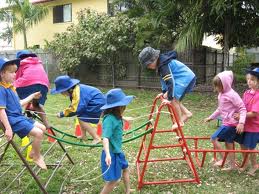
I devise a simple obstacle course using whatever playground equipment the school has.  Slides, monkey bars, polls, ladders and bridges are all useful.  The obstacle course doesn’t need to be intricate, long or complex.  Students should be able to finish it within half a minute maximum.

I take the students out to the playground.  They have no idea what we are doing.  They may ask me, but my reply is “You’ll see.”  The reason why I don’t tell them it’s a maths lesson is because maths has a stigma, and just the mention of it will deflate some students’ expectations.

Usually outdoor lessons require pencils, worksheets and clipboards.  The students are relieved when they find out that none of these implements are required.

With the students congregating around the playground equipment, I tell them that they are going to be doing an obstacle course.  I show them the route they need to take and tell them that each individual will be timed while doing the course.  Each student gets one attempt only, with their personal time written down.  On completion, I order the times privately while the students get a drink of water.

Only the 5 quickest times are read out, so as not to upset or demoralise any of the slower performing students.  Of course, if other students request to know their time, I tell them.  At this point we walk back to the classroom.

On arrival, I write the times in random order on the board.  Using the times, students will take part in some of the activities below, depending on their age and maths proficiency:

Activity 1:  Order the times from quickest to slowest;

Activity 2:   Round the times to the nearest second, tenth of a second etc;

Activity 3:  Work out the total time taken cumulatively over the entire class;

Activity 4:  Work out the average time for the entire class;

Activity 5: Chart the times using Excel and create a chart such as a column graph which presents the data in graphical form; and

Activity 5: Students estimate what time they think they would get should they be given a second attempt.  They will also be asked to give reasons for their answer (e.g. it could be faster the second time around due to a greater awareness of the route, or an improved strategy, yet it could be slower due to fatigue or the pressure to perform).

Even though the main chunk of the lesson is spent doing something that can hardly be called maths, it serves as a basis for engaging the students.  The skills covered in the lesson include measuring time, adding decimals, ordering number, rounding, IT, graphing, averaging and predicting.

It’s a great feeling watching the students get a shock when they find out that the PE lesson they thought they were taking part in, ends up being referred to as a maths lesson.

And ultimately, that’s the point.  Maths is in everything – even the things that give the students pleasure.

Parents, Don’t Do Your Kids’ Homework!

February 7, 2011

The other day I took my daughter to the museum to see an exhibit on Africa.  We sat down to do an African inspired craft activity where I witnessed a loving mother helping her daughter design and decorate her artwork.  I use the word “help” very loosely, because in fact she was basically doing the whole thing for her.  Soon the child’s father joined them.  What ensued was a disagreement between the child’s father and mother over what design strategy to use and what colours worked best.  What was supposed to be an activity for the child, became a chance for the parents to let their child sit aimlessly while her parents took over.

This is a common syndrome when it comes to homework.  Parents often end up doing their child’s homework.  Whilst I understand that they do this out of love as well as to diffuse some of their child’s anxiety over the complexity of the set task, I strongly urge parents to desist from this practice.  Even though in the short-term the child is grateful that the homework can now be submitted without too much heartache, in the long-term they have neither demonstrated capability in successfully mastering the task nor have they managed to calmly work through a challenge.  I accept that parents use homework as a chance to spend some quality time with their kids on a weeknight (where time with the kids is often at a premium), but there are better ways to show your children that you love them and support them.

Whilst there are some strong arguments for abolishing homework (which I will cover at a later date), I’d instead like to focus on what homework should be and how parents can help without feeling a need to take over:

  1. Homework should be revision.  It should not introduce a new concept or skill.  It should simply be a vehicle for students to demonstrate how well they understood what was covered in class that week.  If the child is bringing home work that was not introduced in class, I advise you to see the teacher.
  2. Most teachers give a few days to complete the homework.  I strongly urge my students to use night one to read over the homework and circle any question that they don’t understand.  Then, instead of approaching their parents, come see me the next day.  Of course, I am not restricting the parents from helping their kids, I am merely offering my help as the first option.  In my opinion, parents have already spent most of their youth completing homework, they have paid their debt to education and should now be allowed to enjoy a homework-free life.
  3. When the student approaches the teacher early on about difficulties in the homework, they are showing a great deal of responsibility and assertiveness.  This isn’t lost on the teacher.  So if the students maintains this sort of dialogue with their teacher, extensions are likely to be given should they struggle to meet the deadline.
  4. The best help you can give your children, when assisting them through a homework task is patience and perspective.  Offer your services by all means, but ensure that unlike the girl at the craft table, they end up having ownership of their work.  Kids are not proud of their parents homework, they are proud of their own achievements.  Whilst instilling independence and confidence in children may sometimes feel like an overwhelming proposition, the payoff is huge.  I would rather my students hand in a piece of homework that they took ownership of that was full of mistakes than a brilliant piece ultimately done by mum or dad.

We can easily look at parents who are doing their children’s homework in a judgmental light, whilst calling them enablers and accusing them of spoiling their children.  This is not the right approach.  These parents are often loving parents that don’t know how best to act in a complex situation.

Hopefully the above tips are of some assistance.

Facebook: Changing the Face of Education

February 6, 2011

There is something quite brilliant about social media when it is used in the right way.  Australia has been afflicted by floods, cyclones and fire in the past few weeks, and social media was instrumental in relaying messages and accessing information.  But like all technology, there is always negatives that erode some of the positive aspects.

Social media such as Facebook were invented to connect people, to make them closer, to bring people together.  It is so unfortunate to see the very innovation purporting to connect us being used for quite the opposite.  In the past weeks I have covered Facebook misuse stories such as the unfortunate trend of parents using Facebook to publicly campaign against teachers, the case of the student that bullied his teacher on Facebook, and now unfortunately, comes this new story:

A teacher working at a special needs primary school said it was like ‘working at a zoo’ and that she wanted to throw pupils out of the window.

The teacher at the Oakley School, for special needs children aged between five and 11 in Tonbridge, Kent, also said the pupils shared a ‘particular brand of special germ which made her ill’ on her Facebook page.

The teacher was hauled before education chiefs after they had looked through her Facebook account – which also contained a ‘joke’ about throwing pupils out of the window.

She also criticised pupils, saying they ‘smelled her legs’ and that she was ‘working in hell’ in posts made in September last year.

Parents were furious that the teacher at the 50-pupil school was ‘mocking’ their children on the popular site and demanding she get the boot.

School chiefs have not said whether the teacher was sacked or whether she left after being confronted with the evidence – and say the matter remains ‘confidential’.

Teachers often get quite frustrated with a class or student and say things they later regret.  However, these words far and away exceeded what a typical frustrated teacher says.  What makes it so much worse is that the teacher had the foolishness and temerity to post her thoughts on Facebook.  Teaching is a privilege – especially disabled children who rely on their teacher for support and guidance more than most. No teacher should ever speak of their students in that way!

I have heard teachers talk up Facebook as an educational tool, claiming that it’s perfect for the classroom.  As a teacher myself, I remain unconvinced that it is a wise move to introduce Facebook to the classroom.  Even if half the class are on it anyway, teachers should think twice before endorsing the innovation.

After all, we are seeing far too many cases of Facebook abuse.

You Don’t Get Elite Teachers with Elitism

February 4, 2011

In my opinion, one of the biggest factors concerning the current failures of our educational system is the inadequate and substandard teacher training programs offered by our Universities.  Not just the minnow Universities but also the elite ones.

The idea proposed by Lord Adonis that every secondary school should have teachers who attended elite universities is not only unworkable but costly and simplistic.

Addressing the Independent Academies Association (IAA) conference in central London, Lord Adonis said: “You need a good mix of teachers, of course, at any successful school, but you cannot be a successful school unless you at least have a certain proportion of your teachers who have themselves come from leading universities in to which you intend to send your best students.”

Lord Adonis warned delegates it would not be possible to transform admissions to top universities “unless you can develop a cadre of teachers in your own schools that have that background themselves.”

I attended one of Australia’s elite Universities and I can tell you without a shadow of a doubt that there was precious little that I was taught that was of value to me in the classroom.  From my experience the training of teachers needs an overhaul.  Teaching theory is all well and good but it needs to be complemented with proper practical instruction.  I’ve seen teachers who are more academic  and have sharper intellects than I do, who floundered in the classroom because sometimes all the knowledge in the world on the right and left brain and metacognition can’t help you get through to a hostile or challenging class.

My lecturers were mostly former teachers who left the classroom because they couldn’t manage anymore.  They were a fountain of knowledge when it came to theory, but clearly relieved to be out of the classroom.  Their pearls of wisdom included “Use them or lose them”, concerning the number of paid sick days available to teachers.  Sure, it can be seen as good advice to cash in on your paid sick leave, but it isn’t the positive and responsible message to be sending to future teachers.

Lord Adonis may be right.  Perhaps it is easier to get pupils, particularly those from poorer areas, into top universities when their teachers have studied at those institutions too.  But for my daughter, I am satisfied with a teacher that is caring, dedicated, and prepared to challenge educational norms by experimenting and taking responsible risks.

You don’t need an elite University to educate, prepare and nature an elite teacher.

Bullying a Teacher is not Free Speech!

February 4, 2011

There is appropriate behaviour and then there is inappropriate behaviour.  Bullying a teacher is inappropriate – full stop!  It doesn’t matter if it is in the classroom, the schoolyard or on Facebook – it’s not on.  Students must refrain from slurring the reputation of their teachers.  Is that so difficult to live with?

When a student calls his teacher a “douche bag” and “fat ass” on Facebook, and then gets suspended from school as result, you would think that the matter has been dealt with and all can move on.  But that wasn’t the case when a grade 10 student in California referred to his teacher as a “fat ass who should stop eating fast food, and is a douche bag” in a Facebook post – apparently in reaction to getting a large pile of homework

Such a story should never have made the headlines or been discussed in the media.

Enter the ACLU – a U.S. charity that promotes free speech (and spends most of its time being a general nuisance).  The ACLU couldn’t let the school get away with protecting its teacher from being verbally insulted online.

After learning about the incident, ACLU attorney Linda Lye wrote a letter to the school, asking it to reverse its decision to suspend the student.

She argued that the student’s post did not constitute cyberbullying because it did not “materially or substantially [disrupt] the school environment.” Also, he posted the status update from home during non-school hours.

Didn’t disrupt the school environment?  Who do you think is responsible for establishing and maintaining the school environment? Teachers, Ms. Lye – teachers!  What kind of school environment do you have where it’s considered acceptable to say nasty things about a teacher on Facebook?

And so what if the offence took place out of school.  Does this mean a student can voice their displeasure about their teacher on talkback radio or graffiti insults at the local train station without any punishment?  Let’s just hope our students don’t know any skywriters!

But there’s more:

“Schools have an obligation to provide a safe school environment,” wrote Lye. But “petty comments, insults, ordinary personality conflicts … don’t rise to the level of harassment.”

You see that’s the problem.  Those insults were not petty, they were harmful.  I am sure if Ms. Lye was the subject of similar comments on Facebook she wouldn’t find them so petty.

Of course ACLU were successful with the suspension subsequently erased from the student’s record.

Freedom of speech is not supposed to allow students to insult their teachers on Facebook.  Teachers work every day to keep their credibility and authority intact.  If we allow students to undermine their teachers without consequences, we are sending a terrible message that will have potentially severe ramifications for our education system.

I’m Drowning in Paperwork: Please Pass the Snorkel

February 3, 2011

I admit it.  The allegations are true.  I am a tree-killer!

It’s not my fault, of course.  In the short time I have been teaching, the paperwork demands on a teacher have grown from taxing, to barely manageable, to excessive, and now – out of control!

Why?  Why, at a time when teachers are being criticised for their students’ low performance data and failure to deliver on outcomes, is the paperwork demands of a teacher so high?  Surely time would be better spent developing engaging lessons.

The answer is simple.  The rules applying to all teachers are in place to cover the lesser achieving teachers.  The assumption is that if a lazy teacher wasn’t told what to do, how to think, what to cover, how to plan and who to cater for, they wouldn’t achieve anything.  By forcing teachers to complete crazy amounts of paperwork, they are treating all teachers as if they were inert, fraudulent, apathetic stooges.

Take the planning requirements, for example.

Is planning important?  Absolutely!  Planning is important for three main reasons:

1.  It shows what you are teaching your students in a week, term and year.

2. It helps you organise thoughts and properly sequence the concept or skill you are teaching.

3.  It provides a comprehensive guide for a casual relief teacher, should you not be able to teach your class.

As important as planning may be, it can still go overboard.  In the summer holidays alone I had to complete first term planners for literacy and numeracy, yearly planners for literacy and numeracy, a 10 page integrated planner for my topic of inquiry (Federation) and weekly planners for both numeracy and literacy.  The amount of hours I spend on those darn things doesn’t correlate with how useful they turn out to be.

The rationale that by spending hours upon hours on these planners,  an average teacher will become transformed miraculously into a more focussed and effective educator is just plain wrong.  On the contrary, it forces some teachers to cut corners by mindlessly copying dull, lifeless units from textbooks.  With all that paperwork, teachers often become too concerned with deadlines and time restrictions to go to the trouble of conceiving original and fresh lesson ideas.

And it’s not just planning.  There’s professional learning contracts which chart the goals, reflections and progress of the teacher, class newsletters, letter to parents, school policy feedback forms, incident report documentation, worksheets, homework, curriculum night summaries, parent teacher interview folios and I’m sure there’s more, because … there’s always more!

I’m not trying to play the victim here.  I love my job and understand the value of the above requirements.  It’s just that the sheer amount of  paperwork clearly gets in the way of a teacher’s natural desire to spend less time meeting arcane professional standards and more time excelling in delivering fun, vibrant and engaging lessons.

I’d love to write more on this topic, but unfortunately, I’ve got more paperwork to finish.


Making Maths Fun is Not Mission Impossible

February 2, 2011


I’m no teaching guru – just an ordinary teacher that loves his job. I am a primary level generalist teacher, which means I teach all major subjects such as Maths, English, Social Studies and Science. As much as I love teaching all subjects, I find Maths most exciting.

Is it because I have a background in Maths? Absolutely not. I have an Arts degree.

Is it because I am good at Maths? On the contrary. As a student I would frustrate my teachers no end. As a kid, I had as much chance of passing a maths test as Homer Simpson has of suffering from dandruff!

The reason I love teaching maths is that I find it an untapped and underrated subject for injecting creativity and role-play. Last week I wrote about how primary teachers often struggle to teach maths, as they mostly come from a humanities background.

Commenting on that post, loyal reader and frequent contributor Margaret Reyes Dempsey, wrote, “I’d love to read a post about some of the ways you approach math in the classroom.”

Every week I will endeavour to describe an innovative Maths lesson I have concocted.


Lesson 1: Mission Impossible Maths (Place Value)

I get the students to bring a pair of sunglasses to school for homework. The students invariably ask me what the glasses are for. I tell them it’s a surprise. They automatically think science, perhaps an activity out in the sun. The truth is, the sunglasses are nearly irrelevant, only there to raise curiosity and engagement.

On the day of the lesson I take the kids to our small but homely hall. I carry a briefcase and have on my own pair of “spy” glasses. The kids have no idea what is in the briefcase, and have no clue what is happening. I sit them down on the floor and tell them that there is a problem. There is a mansion close by. In that mansion there is a suitcase. In the suitcase there is a key. The key, in the hands of evil would change the world as we know it. It would give them the power to ban all music except for the golden oldies and make sure that nothing but news is on TV. The kids groan at the prospect. Lucky you are here, I tell them. You are the best spies in the world, and your mission is to break in to the mansion and get the key before they do. I call their names out, adding their secret spy name e.g. Sammy “The Drummer” Smith. The spy name is just another opportunity for me to connect with the interests and skills of my students. I split them into groups based on ability, as the lesson will involve maths problems ranging from basic to more complex.
I take them outside and show what they have to do to break into the mansion. I show them the slide which I call “The Tunnel of Terror.” Getting through the tunnel will be tricky, as a wrong turn would send out the crocodiles. To get through the tunnel without being eaten, group 1 has to work together to order a sheet of 5 digit numbers from lowest to highest number.

I then take the class to the school door, or “Dynamite Door”. To gain access to the mansion, Group 2 has to order a sheet of 5-digit numbers, this time from highest to lowest, otherwise the door will explode.

I show the class the door that leads to the hall, or as I call it “The DNA door.” To gain access to the room in which the suitcase is kept, Group 3 has to bypass the special DNA sensitive handle. To do that, they are given 6-digit numbers to order.

Group 4 has to get past the infra red sensors to get to the suitcase. This involves making as many 4-digit numbers from, for example, 4, 3, 1, 8. Once they have gotten past all 4 obstacles they will face one more test (to be revealed at the time) before being able to open the briefcase. They are told they have 45 minutes and the time starts now …
I distribute the sheets to each group, watching them feverishly try to solve the problems without making a mistake. Each group appoints a checker, to check for a careless error that would complicate this dangerous mission. If a group finishes early, they are quiet, because they rely on the proficiency of the other groups. When all groups are done we go back to the slide. The clock is still running.

The first member of group 1 reads the first part of the answer and when I confirm that it’s right goes down the slide. The other members do the same until they have all slid down the slide. Members of group 2 read out their answers. On getting the right answer each member is allowed access through the door until they are all inside the building. The same for Group 3 with their door and Group 4 with the sensors.

The final challenge involves a representative from each group stepping forward to help break the suitcase code. I tell the 4 representatives that the code number is between 3,500 and 3,600, and they have to guess it right. All I can tell them is whether their guess is higher, lower or spot on.

Once the final code has been broken, the person that correctly broke it gets to open the case and take out the key. They usually get the key with only a few minutes left to spare. You should see the cheers and hugs that come about from unearthing the key. It is such a great bonding experience.

I do this lesson in the second week of the school year. At that stage my students almost uniformly claim they hate maths with a passion. It is only after the lesson that I spill the beans that they had just taken part in a maths activity. In reality, it was nothing more than a set of dry worksheets with a bit of imagination and wackiness added on.

If you feel that this lesson would be suitable for your kids, I’d love to know how it goes.

Do You Suffer From Classroom Envy?

February 1, 2011


There have been a few realities that have caught me off guard since I signed up to being a teacher. The expectation of a meticulously presented classroom is certainly one of them. I’m not an artistic person. My creativity comes from writing and thinking innovatively, but I am inept at decorating. Design school’s nationwide are not flocking to mimic my inimitable low-key style.

I knew that a classroom should look bright, contain student work and be aesthetically pleasing. What I didn’t know, that I have seen learned, was that teachers are inherently obsessive with the look and feel of their classroom. From the table layout to the perfectly hand-crafted posters and signs. Teachers are constantly shopping for material, furniture and accessories to beautify their classroom.

Often it’s a competition. The other day I complemented a colleague about her majestic looking classroom in the presence of another colleague. Only later was I told that by praising that colleague I had potentially upset the other who was already anxious about her classroom not matching up to others aesthetically.

It reminds me of the Christmas lights battle that takes place in some neighbourhoods. What starts out as an expression of good will and festivity, can sometimes turn in to a competitive slugfest. I am not a competitive person at the best of times. In this context, my classroom isn’t simply inferior, compared to the others it looks like a jungle.

My bosses past and present have continually made insensitive comments about the look of my classroom. It’s not as if I don’t try. Sure, it doesn’t size up to the others, but I still maintain it possesses a quaint charm (well that’s my spin on it anyway).

I once apologised to a parent about the look of my classroom during a meeting. The parent responded by pointing out that she doesn’t care what the classroom looks like, just as long as her child is happy and learning well.

Is that representative of other parents? Is it a case of style vs substance? Or, perhaps I am depriving my students of a classroom they can be more proud of. Perhaps like my students I have to improve at skills that don’t come naturally to me. I have to get better at cutting big, beautiful, cardboard letters for my brightly coloured welcome sign.

Is this just my experience? Are there other teachers who have an insecurity over the look of their classrooms? Are any of you envious of the classroom next door?

Modern Educational Thinking: Comedy or Tragedy?

January 31, 2011

Most of us acknowledge that school systems worldwide are deeply flawed and require fresh, new and innovative ideas to get them kickstarted again.  What we don’t need, however, are bizarre, extreme and non-sensical ideas that do more harm than good.

Last week I wrote about the Nebraskan senator trying to pass a bill that would allow teachers and administrators to carry concealed weapons for protection.

This week it’s Florida’s turn to create headlines for putting forward horrendous educational policy:

As lawmakers continue to debate education reform, Florida Rep. Kelli Stargel has a new idea: give teachers a break and grade parents instead.

Stargel has submitted a bill that would let teachers grade parent performance along with student outcomes, reports CNN.

Stargel said that parents should be just as involved in the education process as the students themselves.

“We have student accountability, we have teacher accountability, and we have administration accountability. This was the missing link, which was, look at the parent and making sure the parents are held accountable.”

The bill would give the option of grading parents as “satisfactory,” “unsatisfactory” or “needs improvement.”

Grading parents?  Are you kidding?  Is this some candid camera trick?

Because Stargel so evidently has failed to do her homework, I feel obliged to fill her in on some important points:

1.  Teachers should never judge parents.  It is the teacher’s job to co-operate with parents and assist them, not to assess them.  Unless a parent is abusing the child or engaged in any other form of criminal activity, it is not the business of a teacher to make judgements on parental skills.

2.  Yes, there are parents that do not involve themselves with their child’s education.  Teacher’s should see this as an opportunity rather than an excuse.  The child that doesn’t have actively engaged parents relies even more heavily on their teacher.  This scenario should be seen as a fabulous opportunity to inspire, influence and reinvigorate the child.  Stargel’s idea takes what some teacher’s see as a great opportunity to make a real difference and asks us to see it only as a negative.

3.  By calling on teachers to grade parents, you are turning two crucial stakeholders in a child’s education against each other.  Education is best administered when all major stakeholders are on the same page, or at least can work together harmoniously.  To muddy the waters with negative ideas and forced judgments, Stargel has overlooked the most important ingredients to successful teaching.

In one week we have seen two law makers come up with insane ideas that deal with important issues in a simplistic and scattershot way.  What is it with politicians?  How can such seemingly intelligent people come up such lousy ideas?

Teacher Myth #4

January 28, 2011

Teacher Myth: 4

Teachers should not become emotionally involved with their students


There is a prevailing philosophy in educational circles that teachers are best served by not involving themselves emotionally in the lives of their students.  According to this principle, a teacher must follow procedures without caught up in the difficulties and hardships of their students.

The rationale given for this is as follows:

  1. Teachers are not friends.  Any emotional connection between a teacher and student is unprofessional and breaks the much needed divide between the teacher and student;
  2. Teachers lose their ability to make objective decisions regarding their students when they are emotionally involved; and
  3. If teachers worried about every little thing that concerned their students they would be so overwhelmed and overburdened they would cease to have the energy to work effectively.

So strong are the proponents of this philosophy that some go as far as to say that teachers shouldn’t smile until Easter (Christmas in the US and Europe).  The logic being that is a teacher who smiles loses the authority required to teach effectively.

I personally despise this philosophy.  I find it to be negative, destructive and absolutely outrageous.  If I was forced to teach in such a manner, I would be handing my resignation in before you could say the words, “No smiling!”

When a teacher decides not to become emotionally available to their students, they automatically become emotionally distant.  They become cold, unapproachable, lose their empathy, and lose the respect they thought they could only achieve by acting this way.  Sure they may preside over a quiet and orderly class, but it ultimately would be doing their students more harm than good.

Teachers are the most crucial of role-models.  An integral part of a teacher’s job is to model healthy behaviours.  One of the most humane and important qualities a person can have is empathy.  Without empathy, a person finds it hard to relate and connect with others.  They can become insular, cold and selfish.  These are not the ideal characteristics of a teacher.

Yes, teachers are not friends, and they never should be.  But you don’t have to present yourself as a friend to connect, worry, defend or care about your students.  Sure teachers must be aware that they can’t interact with their students as they would with their friends, but it doesn’t mean that they can’t share a joke or feel bad for a student going through a tough time.

The notion that a teacher loses their objectivity just because they care about their students is utterly false.  Teachers can certainly can maintain objectivity whilst providing care and support for their students.

Whilst I have lost sleep on the account of students’ hardships, it did not overburden me one bit.  In actual fact, I would be far more overtaxed by forcing myself to keep an emotional distance.

This terrible philosophy cost me a number of times during my teaching rounds.  On one occasion it almost caused me to fail.  I had a University inspector sit in on one of my lessons.  Her job was to grade me on my performance.  If I received anything less than a 4 out of 7, I would not only have to repeat the rounds, I would probably have to repeat the entire year.  The lesson went very well.  I prepared my class beforehand for the likelihood that there would be a visitor inspecting me, just so they weren’t freaked out by having a strange adult sitting in the back of their classroom.

I was really happy with how the lesson transpired.  The kids were incredibly well behaved, seemed to enjoy the activity and produced very pleasing work.  After the session, the inspector let me know that she graded me a 4 out of 7.  She said that the class was too well behaved and that she had to mark me down accordingly.  I asked her how teaching a well behaved class could possibly earn me a deduction.  She said that the students were clearly behaving, not because I was a good teacher, but because they liked me and wanted me to succeed.  She said that it is not viable for a teacher to teach in such a friendly manner as opposed to a firm and authorative manner and maintain control of a class.

I absolutely detest this argument.  I had cold, emotionally distant teachers when I was at school, and there’s no chance I am going to become that sort of teacher.  My experience since that episode has shown me that I was right.  Whilst my students are not the best behaved students in the world, and I clearly don’t control a classroom nearly as well as some, my students are happy, respectful, engaged and a pleasure to teach.  They respect me not because I am overly firm, but because they don’t want to disappoint me.  They know I care about them and in turn they want to please me and make me proud of them

Students deserve a teacher who cares about them.  There are plenty of other career options for people who pride themselves on emotional distance such as parking inspectors and tax auditors.