A new study from the University of B.C. shows kids might be generous and giving because it makes them happy, contrary to the popular belief children are inherently selfish.
Adults report feeling better when spending money on other people instead of themselves and research shows the part of the brain that processes rewards is activated when donating to charity.
Three UBC researchers hypothesized very young children — under age two — experience similar emotional benefits from generosity. For adults, the happiness that results from giving could be caused by many things, like conforming with social pressure or receiving rewards.
“But looking at young kids helps us get a little closer to understanding whether this is something rooted in human nature or not,” said Lara Aknin, a PhD in social psychology. Aknin designed the study with her UBC thesis supervisor, Elizabeth Dunn, and developmental psychologist Kiley Hamlin.
This is the first study to look at the emotional benefits of giving in young children.
Aknin cited news and parenting websites that argue young kids are innately selfish and self-absorbed, and she admitted some studies have shown kids can be territorial with their possessions.
“But you also don’t have to look far to see really young kids wanting to share their soggy Cheerios,” she said. “There is this dichotomy when we look at kids, and I think most people’s assumptions are that kids are self-oriented and hoard things for themselves.”
It just goes to show how effectively adults can model good behaviour.
It seems that we have given up on promoting healthy lifestyles and educating our students about nutrition. It’s now all about avoiding obesity:
The American Medical Association on Wednesday put its weight behind requiring yearly instruction aimed at preventing obesity for public schoolchildren and teens.
The nation’s largest physicians group agreed to support legislation that would require classes in causes, consequences and prevention of obesity for first through 12th graders. Doctors will be encouraged to volunteer their time to help with that under the new policy adopted on the final day of the AMA’s annual policymaking meeting.
I heard a very surprising fact on the radio the other week. A nutritionist asked the listeners what they thought the leading cause of death was. Like most, I thought the answer was something like heart disease, obesity or cancer. It was none of the above. Apparently, the leading cause of death is inactivity.
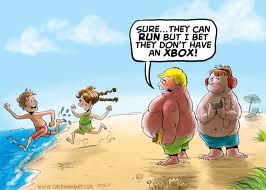
That’s why it is so vital that we help our children to become more active. Here are some helpful hints by Steve Ettinger, a children’s fitness expert and author:
Be creative
Whether you live in an urban, suburban or rural environment, use the space, time and resources you have to find ways to exercise. For example, if you live in the city and don’t have access to outdoor space, find indoor activities. Ettinger also says if kids are sitting in front of the TV, challenge them to exercise in short spurts during commercials. It is a far better solution than having them get up to snack on junk food.
Schedule time to exercise
Writing down time to exercise makes it much more likely that you will do it. Even if it’s just playing at the park, schedule that time in your calendar.
Ettinger also says children who eat poorly will naturally not have as much energy and as high of an activity level as children who eat nutritiously.
Get involved as a family
One of the best ways to get children to exercise is for the family to participate together. Find something that everyone enjoys doing, such as bike riding or going for a walk around the neighborhood, and do it together. That way, there are fewer safety concerns because kids aren’t out by themselves, and everyone in the family – including yourself – gets to benefit from moving around.
Find something your kids enjoy
One reason kids stop exercising is that they are forced into activities they don’t enjoy. If your child doesn’t like a particular activity or organized sport, be patient and take the time to explore different options. Ettinger says if kids find activities fun, they will usually stick with them. He also says it’s best to find an activity for children before age 10 – otherwise, inertia will become a habit.
Educate yourself
Modeling proper nutrition and exercise is the best way to teach your kids about maintaining a proper weight and a healthy lifestyle. Ettinger says he is amazed by the number of parents who have misconceptions about proper nutrition. Seek out resources so you can learn the basics and incorporate these lessons into your own life.
What is the point of filling curriculums with the latest in nonsensical new-age methodology and a raft of programs that are time-consuming but utterly ineffective when our children don’t even know the basics? It seems that we are allowing our kids to become selfish and insular, far more concerned about themselves than the world around them. It is essential that our children become more aware of the world around them.
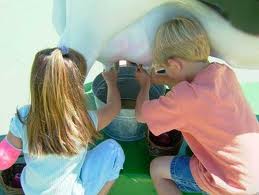
More than a third of 16 to 23-year-olds (36%) do not know bacon comes from pigs and four in 10 (40%) failed to link milk with an image of a dairy cow, with 7% linking it to wheat, the poll of 2,000 people for charity Leaf (Linking Environment and Farming) found.
Some 41% correctly linked butter to a dairy cow, with 8% linking it to beef cattle, while 67% were able to link eggs to an image of a hen but 11% thought they came from wheat or maize.
A total of 6% of those questioned knew that salad dressing could come from rapeseed oil, compared with the national average among all age groups of 24%.
Although four in 10 young adults (43%) considered themselves knowledgeable about where their food comes from, the results revealed a “shocking” lack of knowledge about how the most basic food is produced, the charity said.
Leaf chief executive Caroline Drummond said: “We often hear reports that our food knowledge may be declining but this new research shows how bad the situation is becoming.
“Despite what they think, young adults are clearly becoming removed from where their food comes from.
“Three in 10 adults born in the 1990s haven’t visited a farm in more than 10 years, if at all, which is a real shame as our farmers not only play an important role in food production but are passionate about engaging and reconnecting consumers too.”
The charity, which is organising an Open Farm Sunday event this weekend, also found almost two-thirds of young adults (64%) did not know that new potatoes would be available from British farms in June, and one in 10 (10%) thought they took less than a month to grow.
OnePoll surveyed 2,000 C adults online between May 11 and 14.
Seven very helpful tips on protecting your children online courtesy of expert Dr. Leigh Baker:
1. Spend time with your child on the computer. Put the computer in a place that can be easily accessed by the entire family. Use the Internet with your child to play games, plan for a family vacation, or learn about new places and people. Ask your child to teach you more about the computer and to show you certain tricks he or she may have learned. Not only will you gain computer knowledge, you will also get valuable information on just how savvy your child is on the computer. Make sure to ask your child what he or she likes on the Internet and to show you favorite sites.
2. Let your child know that you will be periodically watching and monitoring his or her online activities. (Internet security software from companies like OnlineFamily.Norton often include parental controls that can help you encourage safe surfing.)
3. Share an online pseudonym, password, and email account with your child. In this way, you can monitor online correspondences and the Internet sites that your child has accessed.
4. Never, under any circumstances, allow your child to have face-to-face contact with someone they met online without your permission. If you agree to the meeting, accompany your child and arrange for it to take place in public.
5. Don’t allow your child to go into private chat rooms without your permission and supervision.
6. Monitor your credit card bill. Many pornographic online vendors require credit cards in order to have access to their sites.
7. Alert your Internet provider if you or your child come across sexually obscene material.
A big thank you must go out for all overprescribing doctors who are doing their bit to have children improve their grades. Thanks to your desire to see children succeed and your devotion to health, you have made amphetamine readily available to all those in need (and even for those not in need).
He steered into the high school parking lot, clicked off the ignition and scanned the scraps of his recent weeks. Crinkled chip bags on the dashboard. Soda cups at his feet. And on the passenger seat, a rumpled SAT practice book whose owner had been told since fourth grade he was headed to the Ivy League. Pencils up in 20 minutes.
“No one seems to think that it’s a real thing — adults on the outside looking in. The other kids in rehab thought we weren’t addicts because Adderall wasn’t a real drug. It’s so underestimated,” said a recent graduate of McLean High School in Virginia, who was given a diagnosis of A.D.H.D. and was prescribed Adderall.
Adderall and similar drugs are not hard to obtain at high school, many students say. They can also be found online.
The boy exhaled. Before opening the car door, he recalled recently, he twisted open a capsule of orange powder and arranged it in a neat line on the armrest. He leaned over, closed one nostril and snorted it.
Throughout the parking lot, he said, eight of his friends did the same thing.
The drug was not cocaine or heroin, but Adderall, an amphetamine prescribed for attention deficit hyperactivity disorder that the boy said he and his friends routinely shared to study late into the night, focus during tests and ultimately get the grades worthy of their prestigious high school in an affluent suburb of New York City. The drug did more than just jolt them awake for the 8 a.m. SAT; it gave them a tunnel focus tailor-made for the marathon of tests long known to make or break college applications.
“Everyone in school either has a prescription or has a friend who does,” the boy said.
At high schools across the United States, pressure over grades and competition for college admissions are encouraging students to abuse prescription stimulants, according to interviews with students, parents and doctors. Pills that have been a staple in some college and graduate school circles are going from rare to routine in many academically competitive high schools, where teenagers say they get them from friends, buy them from student dealers or fake symptoms to their parents and doctors to get prescriptions.
Of the more than 200 students, school officials, parents and others contacted for this article, about 40 agreed to share their experiences. Most students spoke on the condition that they be identified by only a first or middle name, or not at all, out of concern for their college prospects or their school systems’ reputations — and their own.
“It’s throughout all the private schools here,” said DeAnsin Parker, a New York psychologist who treats many adolescents from affluent neighborhoods like the Upper East Side. “It’s not as if there is one school where this is the culture. This is the culture.”
Thank you doctors! What would the educational fraternity do without you?
Unfortunately swearing has become part of our vernacular. Curse words are no longer seen as rude or unsociable and parents are less conscious of avoiding sprouting certain words around their children. Many will not see this as a problem. They will argue that swearing is harmless and a popular fixture of everyday conversation.
I do not find swearing offensive per se, but I am grateful that my parents brought me up to express myself in a more dignified way. It would greatly upset me if my children swore, like many children are nowadays:
CHILDREN as young as three are swearing – and it’s not just “bloody” coming out of the mouths of babes either.
“F—” and “s—” are the first naughty words that toddlers usually let fly.
They pick up swear words from the playground, at home and on TV and they do it because it gets them “maximum attention”, linguistics expert Kate Burridge says.
“In the old days they might have had their mouths washed out with soap or been sent to the bedroom with no supper,” Prof Burridge, of Monash University, said.
“But (now) they get maximum attention and learn how potent these word are.”
Parents say almost 60 per cent of children swear by three years of age and that by kindergarten more than 90 per cent of children have uttered their first rude word, an exclusive Herald Sun survey found.
Etiquette expert June Dally-Watkins said the level of swearing on TV and in public was unacceptable.
“I think it is disgusting,” she said.
“Parents should not permit it.”
Most parents agree with Ms Dally-Watkins – 70 per cent believe schools and parents should do more to crack down on swearing.
But parents (52 per cent) admit their children often hear their first curse at home.
Second was the playground (48 per cent) at school or pre-school, followed by TV (31 per cent).
Most parents (78 per cent) still actively discourage swearing.
Prof Burridge advises parents not to panic if their child swears.
She says: “It is probably best to treat these as ordinary words, because they are.
They have always been an important part of the Australian vernacular.”
Daily Dose. Take time each day to encourage your children to express gratitude. They can do this by making an entry in a family journal or by simply talking about what they are grateful for.
Model Thanks. As with everything, modeling is the best way to teach your children to be grateful. Be lavish with your thanks. Thank your children for hugs. Thank the cashier for ringing up your groceries. Thank the bus driver for returning your students home safely. Letting your children see that you are grateful will encourage them to be so as well.
Establish Rituals. We all know the importance of family rituals. Establishing rituals that highlight being thankful is a wonderful teaching tool. Start dinner with each family member sharing what they are most grateful for. Say goodnight by sharing what you were thankful for that day. Any ritual that based on gratitude will reinforce its power.
Volunteer. Volunteering is a great way for your children to see gratitude in action. There are numerous chances in every community to volunteer. Homeless shelters, nursing homes, and mentoring programs are just a few. There may also be other opportunities closer to home. Perhaps an elderly relative or neighbor could use a hand. It feels good to help others. Therefore, your children not only benefit from that, but they also get to experience the warmth of appreciation. Two things for which they can be grateful.
Assign Chores. Children learn by doing chores. They learn what it means to be part of a whole. They learn their contributions are important. They also learn that most things take effort. Simple household chores can help children learn to be grateful when they benefit from the efforts of others.
Thank You Notes. Writing thank you notes for gifts is a very literal way of teaching your children gratitude. Putting down on paper what they enjoyed about a particular gift, reminds your children why they are grateful for it.
Find Your Gratitude. Always be on the lookout for things to be grateful for and express your gratitude. When your children hear you say things like, “Buster is such a good dog” or “What a beautiful day”, they realize they can be grateful for even the smallest of things.
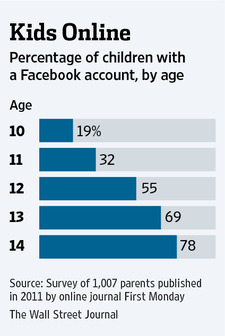
It seems as though Facebook cares more about indoctrinating more young lemmings onto their database than protecting the safety and wellbeing of our children. I have stated before my firm belief that children under 13 do not have the maturity to warrant the privilege of having a Facebook page.
You may argue that many 13 year-olds defy that rule and go and get one anyway. This is unfortunate, and something their parents ought to take an interest in, but at least in this instance there are laws that are being broken. It would be decidedly worse if the age requirement rule was abandoned altogether.
Facebook Inc. is developing technology that would allow children younger than 13 years old to use the social-networking site under parental supervision, a step that could help the company tap a new pool of users for revenue but also inflame privacy concerns.
Mechanisms being tested include connecting children’s accounts to their parents’ and controls that would allow parents to decide whom their kids can “friend” and what applications they can use, people who have spoken with Facebook executives about the technology said. The under-13 features could enable Facebook and its partners to charge parents for games and other entertainment accessed by their children, the people said.
Facebook currently bans users under 13. But many kids lie about their ages to get accounts, putting the company in an awkward position regarding a federal law that requires sites to obtain verifiable parental consent before collecting personal data from children.
Any attempt to give younger kids access to the site would be extraordinarily sensitive, given regulators’ already heightened concerns about how Facebook protects user privacy. But Facebook, concerned that it faces reputational and regulatory risks from children already using the service despite its rules, believes it has little choice but to look into ways of establishing controls that could formalize their presence on the site, people familiar with the matter said.
This morning’s newspaper asked readers to comment on whether or not they thought this woman was fat. Whilst I don’t think this woman is fat at all, it is the question itself that got me worked up.
It reminded me about how obsessed we are about weight, and how this obsession is going to ensure that our children will spend more time aspiring to fit a certain look rather than to become good people.
Nobody seems to care anymore whether a person is caring, selfless, charitable or kind. These are attributes of losers. Surveys that ask what we would prefer to be, beautiful or kind, favour beautiful every time. The rationale being, that nobody is jealous of a kind person in the way they are of a good-looking one.
How are our children supposed to make sense of this?
It upsets me to see Primary aged children so conscious of their weight. It bothers me no end that 8-year olds know everything there is to know about the perfect body size and shape, but have no insights on the correct protocol for offering ones seat to an elderly person on a crowded train. The thought would never have entered their mind.
Haven’t we learnt our lesson? Did we not realise that an obsession with looks leads nowhere. It doesn’t make one happy. Why are we creating kids that follow our sick ways? Why are we perpetuating the message that there’s nothing wrong with gossiping, fakery and selfishness, but eating ice-cream is a sin?
So, no, I don’t find the woman fat. But guess what? I don’t care whether she is fat or not. I care whether she is a good woman, a kind wife, a loving mother, a loyal friend, a friendly co-worker etc. And ultimately, that’s what I want us all to look for.
There are frumpy, unfit people out there, with pale complexions who have unpopular taste in clothes. Some of these people are also tremendously kind and good-hearted. It would be criminal for us to marginalise these people, as some of them are the real beautiful people!








 Topical Teaching