Archive for the ‘Technology’ Category

Are High-Tech Classrooms Just a Lot of Hype?

February 4, 2012

There is a current obsession with technology in the classroom. Even so, I would have thought that it was only sensible to bring as much technology as possible into the classroom. After all, we are trying to help children develop life skills. In today’s world technology is all around us. It is integral that our students have a familiarity if not competency with the latest in technology.

Michael Hiltzik of the LA Times disagrees:
Something sounded familiar last week when I heard U.S. Education Secretary Arne Duncan and FCC Chairman Julius Genachowski make a huge pitch for infusing digital technology into America’s classrooms.

Every schoolchild should have a laptop, they said. Because in the near future, textbooks will be a thing of the past.

Where had I heard that before? So I did a bit of research, and found it. The quote I recalled was, “Books will soon be obsolete in the schools…. Our school system will be completely changed in 10 years.”

the nirvana sketched out by Duncan and Genachowski at last week’s Digital Learning Day town hall was erected upon a sizable foundation of commercially processed claptrap. Not only did Genachowski in his prepared remarks give a special shout out to Apple and the iPad, but the event’s roster of co-sponsors included Google, Comcast, AT&T, Inteland other companies hoping to see their investments in Internet or educational technologies pay off.

How much genuine value is there in fancy educational electronics? Listen to what the experts say.

“The media you use make no difference at all to learning,” says Richard E. Clark, director of the Center for Cognitive Technology at USC. “Not one dang bit. And the evidence has been around for more than 50 years.”

Almost every generation has been subjected in its formative years to some “groundbreaking” pedagogical technology. In the ’60s and ’70s, “instructional TV was going to revolutionize everything,” recalls Thomas C. Reeves, an instructional technology expert at the University of Georgia. “But the notion that a good teacher would be just as effective on videotape is not the case.”

Many would-be educational innovators treat technology as an end-all and be-all, making no effort to figure out how to integrate it into the classroom. “Computers, in and of themselves, do very little to aid learning,” Gavriel Salomon of the University of Haifa and David Perkins of Harvard observed in 1996. Placing them in the classroom “does not automatically inspire teachers to rethink their teaching or students to adopt new modes of learning.”


I am a bit in the middle on this issue. I am in favour of all types of technology in the classroom, just not as a replacement for standard teaching. Those schools that are dominated by devises, lose out from the benefits of teacher/student interaction. But that is not to say that i-Pads in the classroom wont make any difference. It just means that those i-Pads are not more important to education than a quality teacher.

Internet Addiction and our Children

October 26, 2011

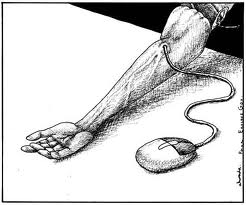
We all love our internet connections and mobile phones and would find it extremely difficult to live without them.  However, addictions are still addictions, and there is no doubt that our children have grown a deep addiction to the internet.  So bad is the problem, that children have become more addicted to the internet than to TV:

Just 18% of children would miss TV most, compared to mobile (28%) and Internet (25%), finds Ofcom research

A new research by communications watchdog Ofcom has revealed that more young British teenagers can do without TV but not without mobile and the Internet.

Ofcom research found that just 18% of children aged 12 to 15 would miss TV most, compared to mobile (28%) and the Internet (25%). However, the research suggests that the teenagers are also watching more TV than ever before, with viewing figures increasing by 2 hours since 2007.

In 2010, children aged 4-15 watched an average of 17 hours and 34 minutes of TV per week, compared with 15 hours and 37 minutes in 2007. Nearly one third (31%) of children aged 5-15 who use the Internet are watching TV via an online catch-up service such as the BBC iPlayer or ITV Player, said Ofcom.

Ofcom’s research said that 95% of 12-15 year olds now have Internet access at home through a PC or laptop, up from 89% in 2010 and 77% in 2007.

Social networking is still one of the most popular uses of the Internet amongst 12-15s. Ofcom said that children are visiting social network sites more often on their mobiles. Half (50%) of 12-15s with a smartphone visit them weekly compared with 33% in 2010.

Children aged between 8-11 are more likely to use Internet for gaming, with 51% saying they play games online on a weekly basis, up from 44% in 2010. 8-11s are also spending more time playing on games players/ consoles compared with 2010 (9 hours 48 minutes – an increase of nearly 2 hours), said Ofcom.

In my school days television addiction was a problem.  Now we have another addiction which comes with the same side-effects.  It creates tired students who have been up so late they can’t concentrate.  It has compromised our children’s capacity to have healthy social interaction.  Playing with a friend has now become messaging a friend.  It’s just not the same.

As soon as people go from the moderate to the obsessive, they lose control of themselves.  Children today are certainly showing the signs of a lack of control, to the point where they are smuggling mobiles in their bags so they can reply to Facebook messages as soon as they receive them.

Kids require rules for their internet usage.  Rules that outline when, how and where they can use it.


Steve Jobs’ Education Legacy

October 7, 2011

Condolences to the Jobs family on the untimely death of a good, decent person who made a telling contribution to innovation and society.  Amongst his crowning achievements, it must be noted, that Jobs leaves a distinct legacy in the education sector:

The death of Apple founder Steve Jobs is an education story as well as a business story.

Among the Jobs tributes flooding the Internet Wednesday night was this from the parent of an autistic child. Although the son does not talk, the parent wrote, he uses Apple’s iPad to communicate.

“Thank you Steve Jobs for helping my son,” the parent wrote on CNN’s iReport site. “You have given us hope we thought we would never have.”

The parent summed up Jobs’ impact on the son very simply: “Steve Jobs saved my son.”

 Jobs’ influence on education is likely to increase after his death. School districts in Florida and elsewhere are turning to the iPad to both engage students and replace textbooks — keeping them more up-to-date at a lower cost.

State Rep. Jeff Brandes, a Pinellas County Republican, believes the devices have the potential to significantly reduce the cost of educating children as less money is available in the state budget.

My daughter has been enriched and engaged by the great variety of educational apps.  I would have loved to learn to read with the tools she has at her disposal.

Thank you Steve!

Kids Are Addicted to the Internet

July 4, 2011

If kids are addicted to internet, Facebook and Twitter, it’s not as if their parents have no options. Reading about how fearful parents are about theeffects of their children’s addictions, I couldn’t help but wonder why they felt so powerless.

A third of all UK parents believe that their children are in danger from the internet and 80 per cent think it is possible to become addicted to social networking sites such as Twitter and Facebook, a new study suggests. It also found that a third of parents even believe that the web can “rewire” a person’s brain.

Internet charity the Nominet Trust, who commissioned the research, say there is no evidence that social networks are harmful in themselves, and that there is no neurological evidence of the web changing brains.

Facebook and Twitter, they suggested, usually in fact reinforce existing friendships, while even playing video games has been show to improve coordination and ‘visual processing skills’.

Parents can take control over their children’s internet access.  Some recommendations include:

  • Capping time on the internet
  • No internet access in their bedrooms
  • Ensuring that they do not have a Facebook page if they are under 13.
  • Imposing strict bedtimes.

If you do not hinder access to the web and have no rules or involvement in how it is used, you have something to worry about.  This addiction is very real and requires a proactive response.

Our Kids Are the Digital Revolution!

June 29, 2011

It’s a very different childhood to the one we experienced.

SEVEN in 10 Australian households have access to the internet at home, one in five of us want to work less and the most popular physical activity is walking, the latest data on social trends shows.

Four out of every five children aged 5-14 use the internet, making them the digital generation, and 86 per cent of households with children aged under 15 have access to the internet at home, the latest Australian social trends study from the Australian Bureau of Statistics shows.

Eighty five per cent of children used the internet for educational activities, 69 per cent played online games, 47 per cent used the internet to download music and 22 per cent used it for social networking.

Only two out of three households without children had access to the internet at home, the study found.