
Archive for the ‘Engaging Students’ Category

Love of Learning Not Considered a Priority

September 8, 2011

There are too many realities of education that are accepted without being properly challenged.  One such reality is that pre-school kids generally love learning whilst older kids don’t.  Pre-schoolers like to ask questions, think creatively, learn new things and take risks with their learning.  Preschool teachers seldom experience the negativity we Primary school teachers see on a daily basis.

A few years later that same Pre-school class will become a Middle-Years Primary class.  Invariably things will be very different.  Academic and social pressures start to show, the kids become self-conscious about getting answers wrong,  are less likely to put their hands up and don’t enjoy their learning as much, if at all.  What has happened in such a short time period?  How did such enthusiastic learners become so dispirited and negative so quickly?  What is the system doing wrong?

In my opinion, part of the blame falls on the endless obsession of benchmarks and accountability.  Whilst it is important to make schools accountable for the quality of their teaching and as important as it is to provide parents with current data about their childs’ progress, look at the price the students have had to pay for this to happen.

The child is subjected to frequent rigorous standardised testing where they are pressured to perform not only to preserve their own self-esteem but also to bolster their school’s reputation.  Innovative, fun and creative lessons are being replaced by pre-tests, practise tests and formal tests.  Trial and error and experimentation is being replaced by methods, short cuts and rote learning.  Curriculums are overloaded, dead boring and politically charged.

And so severe is the pressure from schools to comply with these rigid expectations, that naturally, some are going to unethical lengths to restore their reputations:

Some teachers feel pressurised into altering pupils’ marks to imply they are making good progress in class, research suggests.

Three separate studies suggest teachers are changing assessments after pressure from senior school staff worried about making the school look good.

The government said it trusted schools to make correct judgements when grading pupils.

And all three, being presented to the British Educational Research Association on Wednesday, suggest that some teachers feel pressure from school management to show that their pupils are steadily hitting targets.

Teachers typically have to provide information at least once a term on which level of the national curriculum a child has reached as they move through the school.

The author of one of the studies, Professor Martin Fautley of Birmingham City University, said assessment was being used for an entirely different purpose than was intended.

“Assessment has become a measure of school effectiveness rather than simply a measure of how pupils are performing.

“Management are telling teachers that pupils should be achieving at a certain level, and some teachers are then feeling forced into saying that they have achieved it, whether or not this is appropriate.”

What this article and many ones like it don’t tell you is what implications all this pressure has on the students and on the way teachers teach.

The sad reality of all this is the creative child that buzzes about their experiences on the way back from pre-school later becomes the child that refuses to talk about their day only a few years later.
 

Teachers Who Can’t Engage Should Give Up

July 19, 2011

I am bewildered by the lack of thought and emphasis on engaging lesson content in education.  A few months ago I wrote about the latest trend to hit Australian shores – “Direct Instruction”.  Teachers are given a script and instructed to stick to it at all times.  The script tells them when to pause, what to repeat and what to leave out.  Direct Instruction is being used for teaching maths and spelling in classroom across Australia.  It was designed, in my belief, to ensure that all teachers covered the curriculum regardless of their abilities.

Only trouble is … it is a boring way to teach and a boring way to learn.

Why can’t Maths, English, Science etc. be taught in an interesting and lively manner?  Why does it have to be reduced to a talkfest or an excuse for an endless cycle of worksheets?  If it’s so important to know, why can’t it be taught in a fun way?

Thank goodness for Professor John Hattie:

PROFESSOR John Hattie of Melbourne University drew the wrath of many when he told teachers to ”just shut up”.

In fact, Hattie is supported by a considerable body of research; for instance, North American writers Lorna M. Earl and Andy Hargreaves, who observed lessons no more interesting than watching a haircut in progress. Researchers talk of students drowning in a sea of teacher ”blah”.

The difficulty is that so many people consider themselves experts on schools because they once attended one.

Long-winded accounts of subject matter may have once worked for teachers but young people these days are different from those of the previous century. Their attention spans are shorter, a product, perhaps, of constantly changing multimedia stimuli. They expect – indeed, demand – to be entertained.

Their world is high-tech and their attention is rarely captured by drab or monotonous presentations, which makes engaging in learning one of the chief tasks and difficulties of the modern educator.

The emphasis in schools has changed from teaching to learning and, quite rightly, the critical issue for a teacher is not the quality of their own narrative teaching but rather what their students are learning.

For them to learn effectively, and particularly to master the skills of ongoing learning, of processing apparently limitless information and of developing discernment, they need to be active, not passive, learners.

They need to be ”doers” who can find and process information, rather than just listeners.

Hattie is right: if teachers talk their students into oblivion, the teachers’ knowledge on display might be impressive but what the students gain in terms of content, skills and wisdom will be limited.

Good teachers certainly explain work clearly and test their students’ understanding with strategic questioning. They are masters of content, passionate and excited about their subject, convey a deep interest in their students as people, set high expectations, imbue their students with the confidence to succeed and give students feedback so they know how to improve.

Depending upon their subject, they utilise a wide variety of teaching strategies, working with mind and hand, desk-based and experiential learning, books and screens and also sometimes make their own products.

To read the rest of this brilliantly conceived article, please follow this link.


The Classroom Can Be So Unnatural

June 26, 2011

It mystified me how in the modern era that we live in, we still haven’t properly addressed some fundamental issues effecting the comfort of our students.  The following are three examples:

1.  The Mat – The mat serves a clear purpose.  There are times when the mat is ideal for teaching a new concept or skill or for giving opportunities for students to present their work to the class.  But it must be used in short spurts because it is so uncomfortable.  Sitting in a confined space, without a back rest is not fun at all.  Once, whilst teaching a mat session, I tried it.  I sat on the floor with the kids/ In no time, I’d had enough.  Teachers who use the mat for long, drawn out periods of time should not be frustrated at the child that can’t sit still.  It is to be expected that a naturally restless person will find the challenge just too difficult.

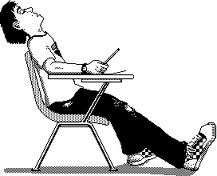
2.  The Chair – Even sitting in a chair for long periods of time is too much to expect.  Why is education often so dormant?  Surely the best forms of teaching allow students to move around.

3.  Lack of Engagement – Currently, there is a strong push to bring back traditional teaching.  This involves lines of handwriting practise, together with pages of maths algorithms followed by reading with comprehension questions.  There are always going to be certain students who will enjoy the safe, predictable, routine side to rote learning.  But on the whole, this methods is nothing short of tedious.  It lacks creativity, energy and critical thinking.  It is unimaginative, noninteractive and downright boring.

I hear teachers complain all the time about how poor attention spans are nowadays.  It makes me wonder whether teachers realise that we are partly to blame.  I can’t concentrate unless I’m engaged  and comfortable in my chair.  I need time to move and stretch and I need to feel as if I am able to express myself.

Why should my students feel any differently?


Is There Anything More Monotonous Than Teaching Handwriting?

June 17, 2011

I am all for teaching handwriting in principle.  Considered a forgotten art by some, I still feel the teaching of handwriting has a place in the modern classroom.  But I do have 2 problems with teaching handwriting:

1.  My writing is neat enough, but hardly the best example of handwriting;

2. I haven’t been able to find a way of teaching handwriting that doesn’t put my students to sleep.

Devotees of handwriting instruction will go to all lengths to promote the skill.  Take this report for example:

New research suggests that we shouldn’t relegate handwriting to the dustbin just yet.

As a piece in the Los Angeles Times reports, “The benefits of gripping and moving a pen or pencil reach beyond communication. Emerging research shows that handwriting increases brain activity, hones fine motor skills, and can predict a child’s academic success in ways that keyboarding can’t.”

In the piece, Karin Harman James, an assistant professor in the department of psychological and brain sciences at Indiana University, explains how neuroimaging has helped researchers discover that “handwriting can change how children learn and their brains develop.”

If handwriting can “change the way children learn and their brains develop”, because it hones fine motor skills, you can say the same about other activities, such as video games.  You wont see reports commissioned on the benefits of video games for the brain.

As i see it, if handwriting is something teachers ought to concentrate on, why are the approaches for teaching it so dry and boring.  Endless lines of copying cursive letters isn’t just monotonous at best, it actually doesn’t change the way my students write.  Sure, they might accurately copy the example in their handwriting book, but in their general writing they revert back to their simple, functional style.  A style that, I’m afraid to admit, mirrors my own.

Is there any method you know of that makes handwriting lessons exciting?  I’ll even settle for less than exciting?  Anything is better than those blasted cursive handwriting books.

Why Students Misbehave

February 16, 2011

There are many reasons given for poorly behaved students:

  • The teacher doesn’t enforce discipline
  • The students are spoilt
  • The students are not parented properly
  • Kids are rude nowadays, and haven’t been properly taught manners.

All these reasons are decent explanations for an unruly child or class.  But there is one glaring omission from this list, which doesn’t get nearly the amount of coverage as other reasons – the students are bored!

My experience with unruly behaviour, is that it is more prevalent in a classroom that is taught in a bland style.  I have observed some brilliantly dedicated and hard-working teachers, who spend countless hours planning their lessons using the latest graphic organisers and programs, only to watch their hard work fizzle before their very eyes.  The most thorough preparation can go out the window when it results in a unsipiring lesson.

So much of today’s educational resources concentrates on breaking skills down, organising thoughts and following scientific trends.  What they fail to do is assist teachers in delivering fun, enjoyable lessons.

The latest trend in Australian education is direct instruction.  Direct instruction involves reading from a script.  In Australia this is how many schools teach their maths and spelling.  The class teacher is presented with a manual and asked to read from a script (the script even tells you when to pint at the board and when to pause!).  The students job is to listen, repeat after the teacher, and answer questions in their workbooks.  No hands are answered, no discussion takes place.  It’s just the teacher talking and the students responding.

The strengths of this style of teaching are worth noting.  The program is comprehensive, it fixes gaps in student learning, it helps improve the student’s listening skills, it makes for a quiet classroom and cuts planning time.  But among the weaknesses for such a program is the fact that it is so boring, firstly for the teacher, and also for the student.

Boring classes often leads to disruptive behaviour.

Have you ever watched the behaviour of teachers during a boring PD or staff room meeting?  And that’s adults!  We can control our behaviour far better than our students.  It’s just that when you are bored, it’s not so easy to maintain focus and avoid distraction.

In my own teaching, I find that my most difficult classes come as a result of an inability to properly engage my students.  Because I am not a strict or authoritative teacher, I rely very much on the strength of my lessons to maintain decorum in the classroom.

Among the many questions we teachers must ask ourselves when we reflect on behavior management in our classrooms is, what are my lessons like?  Could they be more relevant to the interests and life experiences of my students?


The Desperate Need to Keep Students Awake

December 3, 2010

Oh, the things educators do to keep their students awake!  Engaging students are a critical part of teaching.  What we teach shouldn’t just be comprehensive and relevant, but also interesting to the children.  However, there are some terrible methods out there for attempting to bring students out of their slumber.

Take this scatter-brained idea from Germany for example:

Few things rile a teacher more than seeing a pupil chewing gum in class, but a primary school in southern Germany is now actively encouraging them to do so — in order to improve their grades.

Not allowing students to chew, but encouraging!

“Chewing gum is good for the children’s health and improves their cognitive performance,” said Wolfgang Ellegast from the education ministry in Bavaria, home to the Volkenschwand school where the new pilot project is being run.

School headmaster Siegfried Lehr agrees: “The prerequisite for learning with fun is that kids come to school without fear and that they feel happy… Therefore we are encouraging them to chew gum in break and in lessons.”

Does anyone else think that this idea is just plain loopy?  Do they honestly think that by encouraging their students to chew in class they will suddenly get happy and engaged learners?

I am not in favour of restrictive rules in the classroom, yet my school doesn’t allow chewing gum in the classroom, and I stand by that rule.  Chewing gum is messy, distracting and not at all likely to bring about positive outcomes in the classroom.

There are so many bad ideas out there in a bid to get students onside.  For example, the teacher that gives her students a 5-minute break so they can make text messages.

What’s next?  Allowing kids to kick their feet up on the desk for comfort?

Here’s an idea.  How about engaging students with interesting and exciting lessons instead of gimmicks like text breaks and chewing gum?