Archive for the ‘Childhood Obesity’ Category

Banning Home-Made Lunches is a Dreadful Policy

April 15, 2011

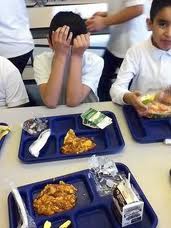
Of all the things to ban at school, who was responsible for this terrible idea? How can you ban children from bringing a home-made lunch to school? How can you force parents into spending money for their child’s lunch when they could provide their own for less cost?  This is another case of we don’t trust parents and their children, so we’ll intervene.  Whilst this philosophy is often generated from good intentions, it seldom leads to good results.

The days of brown bagging it are over for students in a Chicago school. In an effort to encourage healthy eating, their principal banned lunches brought from home.

Elsa Carmona, principal of Little Village Academy on Chicago’s West Side, forbade students from bringing food from home (except those students with a medical excuse) after she noticed kids eating “flaming hot” chips and drinking soda at lunchtime. “It’s milk versus Coke,” she said.

While the goal of healthy eating is a positive one, parents are understandably upset about the Carmona dictating what their kids can and cannot eat for lunch. Not to mention the fact that some parents may be able to send their kids to lunch with a meal that costs less (and one that could be even healthier) than the school’s offerings.

The kids are upset, too. When the Tribune reporter visited the school, one seventh grader led students in a chant of “We should bring our own lunch! We should bring our own lunch!” Students say the school’s food tastes bad. Bad-tasting food, parents say, often means that kids throw away the school lunch and go hungry.

It’s also worth noting, as reported by the Tribune, that the school district receives money from the federal government for each free or reduced-price lunch it serves, meaning that in banning homemade lunches could potentially put more money in the pockets of both the district and the school district’s food provider.

But Carmona maintains her school’s policy is simply about helping students make healthy choices. “Nutrition-wise,” she told the Tribune, “it’s better for the children to eat at the school. It’s about nutrition and the excellent quality food that they are able to serve (in the lunchroom).”

Is anyone surprised that this scheme looks very much like a money-making venture disguised as a realistic attempt in tackling childhood obesity?  What happens to a child who is caught bringing in a lunch from home that is more healthy and nutritious than what the school offers?  Does that child get punished?  What happens if the students hate the menu?  Why should they be forced to eat what they don’t like?

I am all for reducing the amount of junk that students have in their lunch boxes. But at the end of the day, I urge school’s to stop mirroring prisons.  Yes discipline is important, as is routine.  And yes, at times intervention is required.  But why do those involved in forming school policy show a lack of regard for making their students’ time at school a happy, comfortable or at the very least bearable experience?

How about forcing those involved in making stupid rules like this one to eat from the school cafeteria?  How about making them lead my example and banning them from eating a home-made lunch?

And you wonder why there is such a lack of respect from students nowadays?


Asperger’s Teacher Must Be Penalised for His Comments

April 1, 2011

I don’t know enough about Asperger’s Syndrome to be considered an expert on the condition.  Regardless, I am sure of this – a teacher who has a reputation for saying demeaning and insulting things to his/her students with some level of frequency needs to find another profession whether they have Asperger’s Syndrome or not.

I am a deep critic of the general lack of understanding and support given to students with autism and other related conditions, so I want to make it clear that I am not insensitive to the difficulties that such a condition poses on a person’s social skills.

Having said that, it is my belief that Robert Wollkind, if indeed it is proven that he did do what is alleged, needs to be fired for his behaviour:

A Connecticut high school teacher faces the loss of his job after asking a student, who is overweight, if he had eaten his homework. According to the Hartford Courant, officials in the Brookfield school district want to fire Robert Wollkind who, they say, has made a ‘string of inappropriate remarks over his 32-year career.’ Wollkind, a math teacher at Brookfield High School, was diagnosed in 2002 with Asperger’s Syndrome, an autism spectrum disorder in which individuals have normal or above intelligence but struggle with social, communicative and sensory skills. Wollkind has been on administrative leave since the November 2010 incident.

Lawyers representing the school district says that Wollkind has ‘used abusive language to others, including telling one student that he hated him.’ According to the News-Times:

The student, identified as “Student 21,” had been previously teased by peers about his weight, said the school district’s attorney Patrick McHale.

Wollkind’s personnel file also contains reported incidents of him screaming at a student, grabbing a student, and using “abusive and foul language” with students.

Wollkind counters that ‘many of those incidents have been described inaccurately.’

The fact that more than 1,000 Brookfield parents and students have signed a petition supporting him suggests he has some fine qualities as a teacher and that the parents of Brookfield are very understanding.

My issue is with his behaviour.  Teachers have an important role to fulfill that goes beyond the teaching of skills and knowledge.  They are there to build up the confidence of their students, empower them to take responsible risks and help them to realise their full potential.

Comments that hurt and strike at a child’s self-esteem do not belong in a teacher’s repertoire.  It hurts enough in the schoolyard by peers, but to get teased by your teacher is simply not acceptable and potentially destructive to the child.

Whilst I can understand that Mr. Wollkind’s jibe’s were a product of Asperger’s Syndrome, and I am deeply sympathetic to it’s likely influence over his actions, I am not sure I would want him teaching my child.


Are We Obsessed With Obesity?

December 29, 2010


Sarah McMahon, a specialist on the subject of eating disorders, claims that our obsession with obesity has resulted in increased cases of eating disorders.

“Children are being given maths assignments where they have to count calories,” she said.

“Education is helpful for some people but for some with certain personality characteristics, it can tip them over into a disorder.”

Eating disorder support group Butterfly Foundation chief executive officer Christine Morgan said most anti-obesity messages had a high focus on dieting.

This could lead to disordered eating including binge eating and possibly bulimia or anorexia.

I agree that we may be a little obsessed with the term obesity, but I just don’t see the link between obesity and eating disorders.  I imagine that kids are worried about being larger than their ideal size, sometimes much larger, but I don’t think kids are worried about obesity.  I’m no expert, but I don’t think obesity takes up much of our kids head space.  I think they are worried about not being thin enough to be considered attractive or feel pressured to lose weight to fit in.  But obesity?  I can’t see the link.

Regardless, kids should not be hounded by horror stories on the dangers of obesity or made to count calories.  Instead they should be given the reassurance they need to be comfortable in their own skin, the education they need to make healthy choices and the support they need to be self-assured, confident and happy.

A Quarter of 4-5 year-olds Obese!

December 19, 2010

Some very disturbing figures released recently in the UK show that 23.5% of four to five-year-olds are overweight or obese.

Unfortunately it only gets worse in the following years:

One in three (33.4 per cent) of children in their final year of primary school (aged 10 to 11).

In the 2009/10 reception year, 13.3 per cent of children were classed as overweight and 9.8 per cent as obese.

But in Year Six, the final year of primary school, 14.6 per cent were overweight and almost a fifth – 18.7 per cent – obese.

Slightly more boys than girls were either overweight or obese in both age groups.

It is easy to dismiss these figures as an outcome of poor parenting, but schools have the opportunity to become far more proactive.  Schools can intervene by educating both child and parent and offer healthy choices in cafeterias.

Jamie Oliver to the Rescue

November 9, 2010

Just what we needed after last weeks downplaying of our childhood obesity problems.

British celebrity chef Jamie Oliver launched his “Ministry of Food Australia” scheme on Monday, aiming to teach people “down under” how to cook and eat more healthily.

“Today will be a landmark day in the history of Australia’s fight against obesity,” Oliver said in a statement.

As you may know, I am so passionate about this issue, I have written a novel featuring a boy grappling with body image issues.  It is great to see that Oliver’s successful British campaign is now coming to Australia.

Downplaying Childhood Obesity

November 7, 2010

Dr Jennifer O’Dea from the University of Sydney claims that Australia’s childhood obesity problem is an “exaggeration”. An exaggeration?

Dr O’Dea also said the scale of this problem for Australian children has become increasingly overblown.  “People have to stop exaggerating the numbers about childhood obesity – that’s not to say that it is not an issue but you know, hysteria, fear campaigns and exaggeration are not very scientific … In children and teenagers, obesity has been stable really since the late 1990s … and around Australia, it is still about six per cent.”

Whilst I don’t subscribe to hysteria or fear campaigns it is my experience that obesity is still an area of deep concern.  Whilst the numbers may have stabilised in recent years it has not sufficiently decreased.  This isn’t about “blaming and shaming and finger pointing and focusing on how the parents have failed,” as Dr. O’Dea asserts, it’s about taking enough of an interest to help tackle the problem rather than sit on our hands.

I agree with Dr O’Dea that a junk food tax is not the answer, but I find that downplaying the problem beacause it isn’t getting worse is simply not responsible.