Teachers should stop being so precious about time wasted due to toilet breaks. Of course it’s not ideal to have children come in and out of the classroom from the toilet whilst you are teaching a skill or conducting a classroom discussion. I don’t doubt that students have the option in going at break times but choose not to, and they must learn to take those opportunities. I also know that some students use it as an excuse to leave the classroom whilst not needing to go to the toilet.
But ultimately, so what?
The frustrations listed above should never lead to an imposed trial which could result in children wetting themselves. I would rather have lessons impaired on a constant basis that have even one child wetting themself on account of a harsh rule I have introduced.
PARENTS are alarmed that children at a primary school in Melbourne’s east began wetting themselves after the school tested an approach that discouraged them from going to the toilet in class time.
In the Kew Primary School trial, which parents said was conducted without their knowledge, the entire class would go to the toilet if one child needed to go during a lesson.
One mother, who asked not to be named, said she first became aware of the trial when her child wet herself at the front door. ”I said, ‘What happened? She said, ‘I’m holding on, I didn’t want the whole class to have to come with me to the toilet.’ At first when she told me the rule I disbelieved her.”
Another mother took her high-achieving child to the doctor after she wet herself twice at home.
”She hasn’t done this since she was three,” the mother said. ”There was a kind of ripple effect where parents slowly became aware of changes in their children. Children were complaining of headaches, they were constipated, they weren’t drinking water and were coming home with full drink bottles.”
A group of parents wrote to Kew Primary principal Kim Dray, expressing their concern about the trial and citing medical research about the impact of constipation on children.
In an email, obtained by The Age, Dr Dray said the ”whole class” method of toilet break supervision was ”used successfully by some other schools” and was being tested by some classes.
”Team leaders met at the end of last week to discuss the trialled approaches, and although you may find this surprising, some commented on a decrease in disruption to class lessons, especially in senior and specialist classes,” she wrote.
Below is an article that exemplified the absolute lack of balance and common sense in our Education system. To have three separate school uniforms in the one school grounds, with each uniform representing a different learning ability, is just plain insane! It is demeaning, offensive, inexcusable and achieves the exact opposite of what a school is supposed to achieve.
A school isn’t just a place where information is disseminated. Schools serve as a microcosm for society as a whole. They prepare students for the challenges faced in the real world. They are supposed to help children realise the importance of responsibility, empathy, teamwork, leadership, perseverance and acceptance.
Children from aged 11 are being segregated, taught in colour-coordinated buildings, playing in separate fenced-off areas and eat lunch at different times.
The move has caused concern that it is stigmatising children who are placed in lower quality sets.
Pupils are ranked as they leave primary school and placed into one of three mini schools at Crown Woods College, Greenwich.
The brightest go to Delamere and wear purple ties and purple badges. The rest go to Ashwood, which wears blue, or Sherwood, which wears red.
The two latter schools are made up of pupils with mixed abilities but are still streamed into three tiers.
Critics have warned that the move is demoralising for pupils and encourages resentment and animosity amongst those in different sets.
Michael Murphy, the head teacher at the comprehensive, said: “I felt if we made explicit the provision for high-ability children we would be able to attract those children and their parents who would rather not put them in to a grammar.”
“Mrs Thatcher said you can’t ignore the market, you have to respond to it.”
Kevin Courtney, deputy secretary of the National Union of Teachers has condemned the practice.
He said: ‘The idea of taking a large school and turning it into three mini schools is likely to be good for [the school’s] relationships, but streaming is a step backwards. It leads to competition for children rather than improvement in teaching.”
Labelling a student based on their current learning level is extremely damaging. Schools should be doing all they can to eliminating labels and focussing not on what makes us different, but rather, on the things which unite us. We all want to feel respected and cared about. We want to be appreciated for the skills we have and supported in obtaining skills that don’t come easy to us.
Instead of drawing attention to discrepancies in ability, we should be drawing attention to the fact that each and every child has unique qualities which make them important. Just like a vibrant society requires people from all walks of life, political perspectives and skills, a schoolyard does too.
How would teachers like it if they were colour coded according to their teaching ability?
I am glad to see that the recent events in Norway isn’t prompting any knee-jerk reactions in banning violent video games. Although I dislike violent video games and would not want them in my house, I am not an advocate for banning them from the public. As much as I despise violence of any kind, I don’t believe that violent games causes violent outbursts.
THE Australian government will not back away from new classifications for violent video games despite suggestions they might have played a part in the Norwegian horror, says Home Affairs Minister Brendan O’Connor.
State and federal attorneys-general last week ended years of debate and agreed to support an R18+ classification for video games, with the exception of NSW’s Greg Smith, who abstained.
Mr O’Connor has rejected calls for governments to reconsider their position after revelations that the man accused of carrying out the bomb and shooting attacks in Norway, Anders Breivik, was obsessed with violent video games.
“Because there’s a madman who has done just such atrocities in Norway, I don’t think means that we are going to close down film or the engagement with games,” he told ABC TV yesterday.
Mr O’Connor said that under the new R18+ classification, the 50 most popular adult games could no longer be played by 15-year-olds.
When we were young climbing was a great adrenaline rush. I remember the enjoyment I had climbing trees with my friends. Nowadays, climbing trees have been deemed too unsafe and even the basic play equipment has been watered down to avoid accidents, and in turn, fun.
Current safety standards veer public playgrounds towards the benign realm of soft and cushy: sharp edges are covered, jungle gyms and monkey bars are miniaturized to reduce the height children can climb and the whole things are placed on shock-absorbent wood chips or rubber mats to cushion the blow when children inevitably fall.
But are we really doing our children any favors by taking all the risk out of playtime? Some pediatric experts are saying no — in the pursuit of protection for our children, we have stunted their ability to fend for themselves.
In a recent paper published in the journal Evolutionary Psychology, Norwegian psychologists Ellen Sandseter of Queen Maud University in Norway and Leif Kennair of the Norwegian University for Science and Technology write that “risky play” among young children is a necessary experience that helps children learn to master their environments. Protecting children from any risks in their playtime could breed children that are more likely to be anxious and afraid of danger.
“An exaggerated safety focus of children’s play is problematic because while on the one hand children should avoid injuries, on the other hand they might need challenges and varied stimulation to develop normally, both physically and mentally,” the authors write. “Paradoxically, we posit that our fear of children being harmed by mostly harmless injuries may result in more fearful children and increased levels of psychopathology,” they add. “We might need to provide more stimulating environments for children, rather than hamper their development.”
Dr. Gary Smith, director of the Center for Injury Research and Policy at Nationwide Children’s Hospital, says the slow disappearance of more traditional “risky” playground toys has more to do with litigation than with proven safety issues.
Let kids be kids. Grazes and bruises use to be worth it for the sheer enjoyment of the great outdoors.
Whether it was a legitimate attempt or just a joke, it is a very sad and sorry look at the inherent selfishness in some parts of our society.
A VICTORIAN woman is being investigated after offering her two young children for sale to the highest bidder on internet auction site eBay.
The woman, in her early 30s, lives near Geelong. She wrote a “lengthy sales pitch” that included photographs of her son and daughter, both aged under 10.
Several people placed bids on the sickening auction, which has alarmed authorities.
Detectives from the Sexual Offences and Child Abuse unit were alerted to the internet page by a horrified member of the public.
The page has been taken down and the woman’s children could be taken into permanent care.
Victoria Police has decided not to press charges against the mum, who claims the act was a joke.
However, police sources told the Sunday Herald Sun they were disturbed by the incident and in particular the genuine bidders who tried to obtain the children.
Officers continue to probe the people who bid on the children and the Department of Human Services is continuing its investigation into the family.
Below is an excerpt of a book dealing with tips for making the transition between schools more manageable:
Michele Borba, author of “The Big Book of Parenting Solutions,” says moving to an upper-level school is a severe change for kids. Here are Borba’s tips for helping guide your kids through each school transition.
Middle school
Going from elementary to middle school is a big change for kids because they generally go from having one teacher to several. Borba says it’s important that kids find at least one buddy in each of their classes so they have someone to turn to in case they have questions on an assignment or are absent.
She urges parents to walk through the school with their children before the first day so they know how to get from class to class. They should also know how to get to the bathrooms, the cafeteria and the school office.
Organization is important at this stage, since kids will have different classes and teachers. Make sure your kids have a binder with different-colored folders for each class and know where to write their homework assignments.
High school
Once kids reach high school, they won’t want you to walk the school with them before the year starts. What Borba suggests, though, is that you print out a map of the school, and show your children where their classes are and how to get to them. Then have them walk the halls with a buddy before the first day.
Now that they’ll have six or seven classes a day, students will have to be even more organized than in middle school.
In terms of social issues, bullying is a big concern. Borba says the No. 1 place where bullying occurs is in the cafeteria, so make sure your high schooler has at least one friend who has lunch at the same time so he can sit with that person and not feel alone.
No matter how strongly teachers may feel on the subject of climate change, there is no place for scare tactics in a Primary classroom.
PRIMARY school children are being terrified by lessons claiming climate change will bring “death, injury and destruction” to the world unless they take action.
On the eve of Prime Minister Julia Gillard’s carbon tax package announcement, psychologists and scientists said the lessons were alarmist, created unneeded anxiety among school children and endangered their mental health.
Climate change as a “Doomsday scenario” is being taught in classrooms across Australia.
Resource material produced by the Gillard government for primary school teachers and students states climate change will cause “devastating disasters”.
Australian National University’s Centre for the Public Awareness of Science director Dr Sue Stocklmayer said climate change had been portrayed as “Doomsday scenarios with no way out”.
The fear campaign must stop. It is a manipulative and immature tactic by a desperate Government. Our job as educators is to empower and motivate not scare our students senseless.
I refuse to teach Government resource material that has the potential to frighten my students.
A businesswoman in east London re-mortagaged her home to establish a breakfast club after learning that one-fourth of Britain’s primary pupils were too hungry to learn.
Today, Carmel McConnell’s breakfast club – Magic Breakfast – feeds 6,000 chidren every day, Daily Express reported.
At 200 of the most deprived schools, Magic Breakfast gives children a healthy start of juice, bagels and cereal or toast for just 23 pence, with many often having not eaten since the previous school lunch.
Carmel said: ‘My work was advising big business on building trusted brands. I ended up going into schools to research a book on corporate activism and found that many of the teachers were having a whip-round and bringing food into school each morning so they could give their pupils something to eat.
‘Without food, the youngsters are unable to concentrate, behave properly or to learn. I immediately bought a whole load of loaves and dropped them off at our local schools in Hackney (in east London) where the teachers had expressed a real need.
‘I then re-mortgaged the house when I realised just how widespread this problem was and how little it would take to put it right.’
Valerie Figaro, head of Randall Cremer Primary School, east London, said Magic Breakfast transformed the lives of many of her pupils.
‘When children get up they won’t have eaten for 10 to 12 hours and we are asking them to expend energy by using their brains without any fuel,’ said Figaro.
Carmel, who draws support from large corporations, hopes to advise schools on raising funds themselves for breakfast clubs.
Breakfast is such a crucial meal. I am a big supporter of the Breakfast Club program, and am delighted to here it is working well.
YEARS of public campaigns to persuade children to eat breakfast are paying off, with the number of children consuming a morning meal rising in the past decade. A national study by the University of Sydney has found primary and secondary school students are more likely to eat breakfast. Thousands of schoolchildren from years 2 to 12 were surveyed in 2000 and 2006. A follow-up study is planned for next year.
Researchers found high school students in particular were now more likely to eat breakfast.
University of Sydney nutritionist Jennifer O’Dea credited public campaigns and school ”breakfast clubs” for the improvement.
”It’s such a simple thing but it feeds the child’s brain, it improves their behaviour and reduces their risk of overweight and obesity,” she said.
The number of high school boys missing breakfast fell from 19.9 per cent to 12.1 per cent and the number of high school girls fell from 27.7 per cent to 18.7 per cent.
In primary school, the number of boys who did not eat breakfast fell from 9.4 per cent to 6 per cent, while the number of girls fell from 9.6 per cent to 6 per cent.
Dr O’Dea expects to see greater improvements when surveys are conducted again next year.
The nutritional quality of breakfast affects a child’s concentration and learning ability, Dr O’Dea found in separate research in 2008.
Congratulations to all schools that have invested their time and energy into Breakfast Club. May it continue to assist students in desperate need of a nutritious meal.
Experienced teachers always say, “expect the unexpected”, but who could ever expect to be teaching while there is a shootout outside the classroom. Mexican kindergarten teacher Martha Rivera Alanis, shows us what a fabulous teacher can achieve in the worst of circumstances. As a shootout takes place outside her window she calmly reassures her young students before engaging them in a sing-a-long.
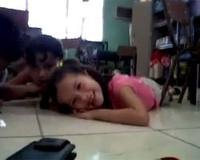
In the video, the frightened but determined voice of a schoolteacher is heard as she attempts to maintain calm among a group of kindergartners lying on the floor before her, asking them to join her in a singalong as gunfire shatters the air outside.
The teacher refers to the children as “my love,” “precious” and “little ones” during the stirring clip filmed last week in the city of Monterrey, in northern Mexico. It’s gone viral, igniting once more a public debate over the government’s campaign against drug gangs and earning accolades for maestra Martha Rivera Alanis, reports the Associated Press.
The Nuevo Leon state government honored Rivera for “outstanding civic courage” in a ceremony today.
The 33-year-old mother of two said she was frightened, but that her “only thought was to take their minds off that noise.” The song she chose during the ordeal is a Spanish-language version of a tune popularized by the children’s TV program “Barney and Friends,” and makes reference to chocolate droplets falling from the sky.
Rivera filmed the video during a gunfight Friday in which five people were killed at a taxi stand in La Estanzuela, a district in south Monterrey. According to a local news site, Regioblogs, the teacher posted the video to her Facebook account and then was asked permission to have it reproduced on YouTube and linked to the site. So far the original clip has garnered more than 714,000 views.
“We do drills constantly, because the area where we are is a high-risk zone,” Rivera said, according to reports. The children, she added, “behaved in the way we had practiced.”
I hope to never be in the situation Martha Rivera Alanis was in, but should I ever find myself in a delicate or dangerous predicament I can now draw on the example of this fine, selfless, courageous and dedicated teacher. What a wonderful role we can play in our students’ lives. What a positive and calming influence we can have on them.
Thank you Martha Rivera Alanis for showing us how it’s done!






 Topical Teaching