Posts Tagged ‘Wikipedia’

There is Still Some Love for the Forgotten Class Whiteboard

March 22, 2012

I’ve inherited a class that does not have a whiteboard. Well actually it does, but it is covered up by a Smart Board. It seems that my school was so excited to install brand new Smart Boards (interactive whiteboards) that they set it up directly on the existing board. They were so keen to set up the Smart Boards it didn’t even occur to them to take down the whiteboards first!

As much as I love my Smart Board, I find it much easier to write and present maths problems on a traditional whiteboard.

So I got my school to order one for me. Last December ….

And it only arrived today!

Meanwhile, my Smart Board died two weeks ago. The projector just decided it couldn’t facilitate any longer (I hope it didn’t have anything to do with my ghastly interactive whiteboard handwriting). A teacher without a whiteboard is like a carpenter without a drill. It is a huge challenge to teach without a board. A challenge that has proved frustrating and in a sense, quite revealing.

It has taught me that no matter how incredible modern technology has become. No matter how much education has been transformed because of touch screens, blogs, the internet, YouTube, Wikipedia etc. Nothing can replace the simple whiteboard!
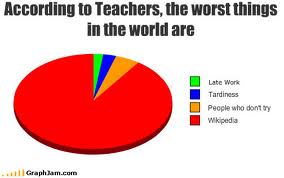
Wikipedia Becoming Accepted in Educational Circles

November 6, 2011

I read a very interesting article about Wikipedia and its newfound legitimacy in education.

Below are some excerpts from the article:

The Toronto District School Board, for instance, lists Wikipedia as a primary source in a research guide it hands out to students, while Wikipedia will expand its college program to a high school in Virginia next year.

Reliable is not a word that traditionally has been associated with Wikipedia, but that’s changing.

The change began in 2005 when the prestigious science journal Nature compared Wikipedia to Encyclopaedia Britannica and found Wikipedia to be almost as accurate as Britannica, a finding that set off a war of words between the two institutions.

The evidence mounted this year, when Brigham Young University in Utah found that Wikipedia was a reliable place to learn about U.S. politicians. The school’s study found few inaccuracies in the biographical and voting details of gubernatorial candidates.

And, in September this year, a study published in the Journal of Oncology Practice found that cancer information on Wikipedia was as accurate as information on peer-reviewed, patient-oriented websites.

As a teacher, my issue isn’t so much with the accuracy of Wikipedia so much as the laziness it inspires.  I want my students to research using a number of different mediums and publications.  Wikipedia tends to be a ‘one-stop shop’ for students looking for information on the run.
I am really happy to read that Wikipedia have improved their reputation.  I only wish students would extend their repertoire a bit in the name of authentic research skills.