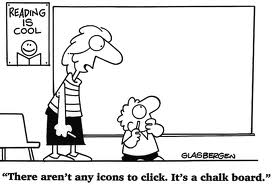
As a classroom teacher, I see new parents taking guided tours of our school all the time. Nowadays parents find it particularly important to sign up to a school while their child is still a newborn. This means that schools are becoming inundated with requests from new parents for guided tours.
During these tours parents openly show an appreciation for the Smartboards that adorn the classrooms.
“So there’s a Smartboard in every single classroom?” they ask in amazement.
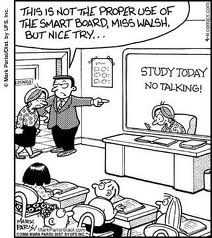
As impressive as Smartboards look, in itself they haven’t revolutionised teaching. The challengef or us is to get the technology to compliment our teaching rather than become the focus. Similarly, it is also essential that this technology doesn’t become a mere piece of decoration that manages to impress parents without actually being used for any real educational benefit:
A disruptive technology is one that radically alters an existing market – the iPod displacing the Walkman, for example, or tablets eating into sales of PCs. In the same way, new technologies have the potential to disrupt the education system, bringing about major changes in the way pupils learn and challenging the way schools and colleges are run.
… everyone seems to agree that, as exciting as new technologies are, they should not be seen as a panacea for all ills, or a short cut to more effective teaching. “We’ve seen a lot of whiteboards go into schools, and that’s good because you can have more interactive things on the screen,” says Mills. “But it doesn’t necessarily shift the paradigm of a teacher talking to kids. If done badly, all that investment can just reinforce a model of teaching that isn’t putting the tools in the hands of children.”
Teachers will need more support and resources to embrace the digital classroom idea. “When people spend so much money on the hardware and software, the advice would be you need to spend at least the same amount of money on staff training and development,” says Doug Belshaw, a researcher at JISC infoNet, which provides resources promoting good practice and innovation within the education sector, and co-kickstarter of the Purpos/ed Community Interest Company. “Otherwise you’re never going to get any effectiveness from it.”
Of course, many teachers already know the obvious: that new technologies have the potential to be a disruptive force of the good kind, breaking down barriers between schools and the wider world, the timetable and more flexible forms of learning, pupil ability and the requirements of the curriculum. They can empower children and better prepare them for life in our fast-paced online world. But we are yet to make the leap from pockets of innovation to a mainstream embrace of the digital classroom within our schools.


 Topical Teaching