The policy of banning the application of sun block at school has been exposed as a complete and utter failure. When teachers are applying lotion on themselves and making comments about how the children are burning up, it becomes clear that this policy, as well-intentioned as it may have been, is cruel and must be repealed.
Michener says school officials have promised her the sunscreen policy will be changed by fall, thanks to a change in state law that gives schools new leeway on handling over-the-counter drugs. Shannon McMinimee, a lawyer for Tacoma Public Schools, said in an e-mail that the school board was expected to review the policy but would need to seek guidance from state officials and health experts first.
But sunscreen rules are common. They typically stem from state and local policies that stop kids from bringing any drug — including non-prescription drugs — to school, says Jeff Ashley, a California dermatologist who leads an advocacy group called Sun Safety for Kids.
Sunscreens are regulated as over-the-counter drugs, so many districts treat them like aspirin, just to be safe, he says.
It time for all schools in all states to follow California’s lead. This is a bad policy. Change it now!
Some of my fondest memories and proudest moments in teaching have been related to working with children with extreme behavioural issues. Sure, I could have blamed the home situation of these students, but how is that going to fix the problem? In teaching, one has to expect that they will encounter many students who have violent tendencies and flawed parents.
A growing number of primary school children are too violent and disruptive to be in school, the Government’s behaviour tsar said today.
Charlie Taylor, the former headteacher who advises ministers on discipline, said; “There is a group of children showing very extreme behaviour, very difficult, challenging, violent behaviour – often quite young children. There is an increase in those kind of children.”
They would often resorting to kicking or biting fellow pupils in the classroom, MPs on the Commons select committee for education were told..
He said a school could be “a good school” in terms of the discipline it promoted but still find itself unable to deal with such children
Mr Taylor’s comments follow claims from headteachers’ leaders that children often arrive at primary school — lacking in personal skills and ill-equipped to communicate with their fellow pupils.
They have put the blame on parents who fail to communicate with them – and allow them to remain in front of computer screens or TVs for the most part of the day.
We teachers need to stop blaming others and accept that we have a difficult job to do that requires doing. If we are the only stable presence in a child’s life, so be it. If we invest the time and energy into kids who are difficult and self-destructive, we have a realistic chance to make small but crucial changes to their self-esteem.
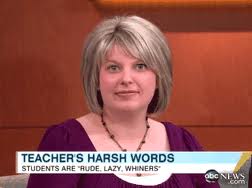
A high school teacher who branded her students ‘frightfully dim’ and ‘lazy whiners’ on a scathing blog has finally been fired for her ‘unsatisfactory performance’.
Natalie Munroe’s blog garnered nationwide attention when it was discovered by her students in February 2011, and she was suspended.
The English teacher was allowed to return to Central Bucks High School East in Philadelphia, but her classes were monitored by other staff.
Now the school board has dismissed Munroe, who taught 11th grade, by a 7-0 vote based on a year of class observations.
‘Ms. Munroe was, at best, a satisfactory teacher and was experiencing performance difficulties well before her blog became an issue,’ the board’s president, Paul Faulkner, said, the Philadelphia Inquirer reported.
Perhaps Ms. Munroe could entertain becoming a professional blogger.
Growing numbers of children are failing to develop properly at a young age because of the toxic pressures of modern life, it was claimed.
The powerful lobby of childcare experts said that many “commercially vulnerable” under-16s were spending too much time sat unsupervised in front of televisions, games consoles and the internet in their bedroom instead of playing outdoors.
Children are also among the most tested in the Western world after being pushed into formal schooling at an increasingly young age and more likely to be exposed to junk food and poor diets than elsewhere, they said.
The comments were made as a new group – the Save Childhood Movement – was launched today in bid to highlight the multiple threats facing young people.
With an explosion of ADHD medications prescribed I imagine that medication sharing and misuse will become an everyday reality:
A US suburban “supermum” has revealed how she became addicted to her son’s ADHD medication to help her do housework.
The woman is one of the growing number of mothers turning to prescription drugs to help them deal with their daily parenting responsibilities, the US ABC Network reports.
Betsy Degree, from suburban Minneapolis, said she started taking prescription medicine to deal up with the demands of being a mother-of-four.
“I grew up in a house where my mom was very neat,” she said.
“Everything was really clean, beautiful dinners every night and that didn’t come naturally for me.”
A few years ago after stealing one of her son’s Adderall pills she found she was able to be the mother she wanted to be.
“I was able to get all the stuff done around the house,” Ms Degree said.
“I was able to cook the dinner and have everything perfect.”
Many will argue that upkeep isn’t a sufficient reason for taking ADHD medication. I would argue that if maintaining concentration is a good enough reason to prescribe drugs to children why wouldn’t it be a good enough for adults who need help in getting stuff done around the house? Why is one problem so much more urgent than the other?
Another thing that interests me is this quote by addiction treatment facility Hazelden chief medical officer Dr Marvin Seppala:
Dr Marvin Seppala told ABC News the rising incidence of addiction was a “significant problem”.
Research thus far suggests that individuals with ADHD do not become addicted to their stimulant medications when taken in the form and dosage prescribed by their doctors.
I am deeply concerned that this is an addictive drug with or without prescription, whether it be taken by child or adult, homemaker or student, ‘supermum’ or naughty child.
Last month I wrote about Lynden Dorval, a teacher suspended after 35 years of service for daring to challenge a moronic rule that says you can’t give a zero grade. This includes situations where the students fail to complete or even give in their assignments.
Today I read that the suspension may well turn into a sacking. It seems that principal Ron Bradley isn’t thrilled that Dorval didn’t leave any lesson plans for the substitute teacher. Who in their right mind would expect a suspended teacher to provide the school with lesson plans?
Tell me Mr. Bradley doesn’t sound like an infant fighting over a crayon in this exchange:
Lynden Dorval was told in a letter he received last week from Ron Bradley, principal of Ross Sheppard High School, that he is facing termination.
After criticizing Dorval for not returning unmarked exams, assignments and lab reports after he was suspended — and not leaving lesson plans for his replacement — Bradley informs the physics and science teacher that his job is on the line.
“I find it utterly reprehensible that you would sit on these exams and assignments for weeks without alerting the school,” Bradley wrote in the letter, which is dated June 18th.
“Your behavior is unbefitting a professional. It is also ironic in light of your very public pronouncements about your concern for the welfare of your students.
“Your habitual refusal to obey lawful orders, your repeated insubordination, and your obvious neglect of duty force me to consider recommending termination of your teaching contract with Edmonton Public Schools.”
Out of ten, I give Bradley’s handling of this situation a …. zero!
Education achievement in the U.S. has fallen to the middle of the pack among developed nations, according to the 2009 Program for International Student Assessment (PISA) report, which ranked the knowledge of 15-year-olds in 70 countries. The U.S. ranked 14th in reading, 17th in science, and 25th in mathematics.
Is the American style worth implementing in my own classroom? Do American teachers even know what the “American style” is?
I have just watched the second installment of the How toUnmake a Bully trilogy with my students. The second film focusses on the topical issue of Bystanders. It has always been difficult for teachers to motivate bystanders to act. The standard anti-bullying programs and resources don’t measure up to this brilliant piece of film-making.
It only took twelve days for teacher Mike Feurstein and a cast of elementary students from Glendaal Elementary School to shoot this movie. From the extraordinary shot of a child with cafeteria tray in hand being rejected from every table he tries to sit at to the chilling scene where a bystander gets the courage to speak out against a bully, this film speaks to children in a way other resources fail to.
I watched the film with my students and they were enthralled, They even gave it a standing ovation during the closing credits. This is a tribute to Mike’s well drawn characters and his use of comic and superhero references. The idea that children have the very same super powers they pretend to posses during role play situations is a stroke of genius.
Here is a movie that is perceptive, knowing, vibrant, beautifully constructed and shot and will get your students reflecting about their experiences, behaviour and future choices. Throw away your old tired resources and bring these films into your classroom.
(I suggest you show them the first film in the series, How to Unmake a Bully, before you show them Bystanders – How to UnMake A Bully, Volume 2 ).
If children are going to great pains to hide their online activity from their parents then it stand to reason that parents are well within their rights to monitor what their children are doing. Some will argue it’s spying, I believe it’s being responsible and looking out for the child’s welfare.
We would like to thing that our children make responsible decisions and are honest about their activities – but that is often not the case:
Parents can now use an array of tools to keep up with the digital lives of their children, raising new quandaries. Is surveillance the best way to protect children? Or should parents trust them to share if they are scared or bewildered by something online?
The answers are as varied as parents themselves. Still, the anxieties of parenting in the digital age have spawned a mini-industry, as start-ups and established companies market new tools to track where children go online, who they meet there and what they do. Because children are glued to smartphones, the technology can allow parents to track their physical whereabouts and even monitor their driving speed.
If, a few years ago, the emphasis was on blocking children from going to inappropriate sites on the family computer, today’s technologies promise to embed Mom and Dad — and occasionally Grandma — inside every device that children are using, and gather intelligence on them wherever they go.
A smartphone application alerts Dad if his son is texting while driving. An online service helps parents keep tabs on every chat, post and photo that floats across their children’s Facebook pages. And another scans the Web in case a child decides to try a new social network that the grown-ups have not even heard of yet.
I am sickened by the forces that are trying to get impressionable parents to see ADHD drugs as if they were multivitamins. There are many factors that result in a loss of concentration in the classroom. They include diet, sleep deprivation and uninspiring, non engaging teaching styles.
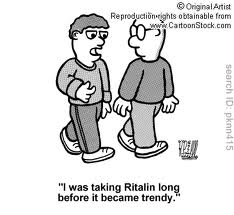
Kids with attention deficit hyperactivity disorder, or ADHD, struggle in school. Their wandering concentration makes it tough to follow directions, absorb lessons, and finish homework. Now, new research may offer a partial solution.
The large new study funded by the government of Iceland suggests that stimulant medications like Ritalin may help to prevent some of those academic declines.
The study, published in the journal Pediatrics, found that the earlier kids get started on drug treatment, the less their academic performance was likely to suffer between fourth and seventh grades, especially in math. And girls saw a bigger benefit than boys did from early drug treatment.
Why is a lack of concentration viewed with such negativity?







 Topical Teaching