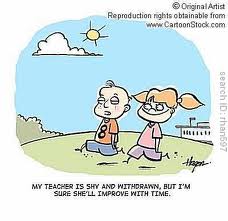
Notionally, I have no problem with being evaluated. I suppose it is a good way for me to get objective advice from an impartial other. This could then potentially have a positive effect on my future teaching.
But I have been evaluated before. All Australian student-teachers are put through a series of evaluations before qualifying for their teaching degrees. My evaluations proved a heart-rendering, confidence sapping, irritating, period of despair. The feedback I got was that “the students liked me too much”, that they “behaved for me rather than because of me”, that I “teach too much like a male teacher” (what does that even mean?) and that I “need to be more emotionally distant” ….
One of the main reasons that I decided to become a teacher was so that I could offer my students an alternative from the garbage I got dished up when I was a child. The sad thing is, if I get evaluated, there is a great chance it will be by the very type of educator I am trying not to be.
Bill and Melinda Gates touch on it in their brilliant piece in The Wall Street Journal:
It may surprise you—it was certainly surprising to us—but the field of education doesn’t know very much at all about effective teaching. We have all known terrific teachers. You watch them at work for 10 minutes and you can tell how thoroughly they’ve mastered the craft. But nobody has been able to identify what, precisely, makes them so outstanding.
This ignorance has serious ramifications. We can’t give teachers the right kind of support because there’s no way to distinguish the right kind from the wrong kind. We can’t evaluate teaching because we are not consistent in what we’re looking for. We can’t spread best practices because we can’t capture them in the first place.
Our Education System is so flawed at the moment that I am not sure effective teaching can be properly measured. There are plenty of teachers like me (most are far better) that want to buck the trend because we want something different for our students. We want to try new things, we want to engage our students, and against the advice of some we do not want to practice ’emotional distance’ from our students. If we were evaluated we may be judged poorly, but our students love our classes and their parents are satisfied with our performance and that should be all that matters.
And why just evaluate the teachers? Who is evaluating the Principals? What about the school culture?
It’s like evaluating the pasta in a pasta dish. Sure the pasta is the most important ingredient, but if the sauce and other ingredients tastes bad, no matter how good the quality of pasta is, the dish will be a failure.
Until we have a better measure for judging good teaching and until we evaluate all stakeholders and elements of education together, the results will be tainted and ‘unique’ teachers will be forced to follow the herd.


 Topical Teaching