Posts Tagged ‘Apple’

Facebook Doesn’t Seem to Care About Kids

June 5, 2012

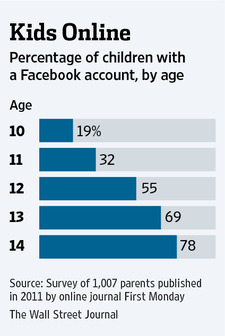
It seems as though Facebook cares more about indoctrinating more young lemmings onto their database than protecting the safety and wellbeing of our children. I have stated before my firm belief that children under 13 do not have the maturity to warrant the privilege of having a Facebook page.

You may argue that many 13 year-olds defy that rule and go and get one anyway. This is unfortunate, and something their parents ought to take an interest in, but at least in this instance there are laws that are being broken. It would be decidedly worse if the age requirement rule was abandoned altogether.

A new proposal to allow children under the age of 13 to have legal access to Facebook is the first step in a concerted effort to rescinding these important regulations:

Facebook Inc. is developing technology that would allow children younger than 13 years old to use the social-networking site under parental supervision, a step that could help the company tap a new pool of users for revenue but also inflame privacy concerns.

Mechanisms being tested include connecting children’s accounts to their parents’ and controls that would allow parents to decide whom their kids can “friend” and what applications they can use, people who have spoken with Facebook executives about the technology said. The under-13 features could enable Facebook and its partners to charge parents for games and other entertainment accessed by their children, the people said.

Facebook currently bans users under 13. But many kids lie about their ages to get accounts, putting the company in an awkward position regarding a federal law that requires sites to obtain verifiable parental consent before collecting personal data from children.

Any attempt to give younger kids access to the site would be extraordinarily sensitive, given regulators’ already heightened concerns about how Facebook protects user privacy. But Facebook, concerned that it faces reputational and regulatory risks from children already using the service despite its rules, believes it has little choice but to look into ways of establishing controls that could formalize their presence on the site, people familiar with the matter said.

Are High-Tech Classrooms Just a Lot of Hype?

February 4, 2012

There is a current obsession with technology in the classroom. Even so, I would have thought that it was only sensible to bring as much technology as possible into the classroom. After all, we are trying to help children develop life skills. In today’s world technology is all around us. It is integral that our students have a familiarity if not competency with the latest in technology.

Michael Hiltzik of the LA Times disagrees:
Something sounded familiar last week when I heard U.S. Education Secretary Arne Duncan and FCC Chairman Julius Genachowski make a huge pitch for infusing digital technology into America’s classrooms.

Every schoolchild should have a laptop, they said. Because in the near future, textbooks will be a thing of the past.

Where had I heard that before? So I did a bit of research, and found it. The quote I recalled was, “Books will soon be obsolete in the schools…. Our school system will be completely changed in 10 years.”

the nirvana sketched out by Duncan and Genachowski at last week’s Digital Learning Day town hall was erected upon a sizable foundation of commercially processed claptrap. Not only did Genachowski in his prepared remarks give a special shout out to Apple and the iPad, but the event’s roster of co-sponsors included Google, Comcast, AT&T, Inteland other companies hoping to see their investments in Internet or educational technologies pay off.

How much genuine value is there in fancy educational electronics? Listen to what the experts say.

“The media you use make no difference at all to learning,” says Richard E. Clark, director of the Center for Cognitive Technology at USC. “Not one dang bit. And the evidence has been around for more than 50 years.”

Almost every generation has been subjected in its formative years to some “groundbreaking” pedagogical technology. In the ’60s and ’70s, “instructional TV was going to revolutionize everything,” recalls Thomas C. Reeves, an instructional technology expert at the University of Georgia. “But the notion that a good teacher would be just as effective on videotape is not the case.”

Many would-be educational innovators treat technology as an end-all and be-all, making no effort to figure out how to integrate it into the classroom. “Computers, in and of themselves, do very little to aid learning,” Gavriel Salomon of the University of Haifa and David Perkins of Harvard observed in 1996. Placing them in the classroom “does not automatically inspire teachers to rethink their teaching or students to adopt new modes of learning.”

I am a bit in the middle on this issue. I am in favour of all types of technology in the classroom, just not as a replacement for standard teaching. Those schools that are dominated by devises, lose out from the benefits of teacher/student interaction. But that is not to say that i-Pads in the classroom wont make any difference. It just means that those i-Pads are not more important to education than a quality teacher.

The Meteoric Rise of the Educational App

January 25, 2012

We are in the midst of an educational app bonanza. The educational app is fast taking over, with the startling statistic that more than a quarter of all parents have downloaded apps for their children to use. In a recent study entitled, iLearn II: An Analysis of the Education Category on Apple’s App Store, the popularity of the educational app was discussed as was recommendations for future growth.

Below are some of the findings of the report:

1. Apps are an important and growing medium for providing educational content to children, both in terms of their availability and popularity.

  • Over 80% of the top selling paid apps in the Education category of the iTunes Store target children.
  • In 2009, almost half (47%) of the top selling apps targeted preschool or elementary aged children.  That number has increased to almost three-­‐quarters (72%).
  • The percentage of apps for children has risen in every age category, accompanied by a decrease in apps for adults.

2. Early learning apps for toddler/preschool are particularly prominent. Developers should consider potential saturation of this market.

  • Apps for toddlers/preschoolers are the most popular age category (58%), and experienced the greatest growth (23%).
  • General early learning is the most popular subject (47%), and there are significantly more general early learning apps than the second most popular subject (math, 13%).

For those interested in a more comprehensive summary of the report please follow this link. If you would like to read the entire report please click on this link.

The Argument Against the Apple iPad for Education Scheme

January 20, 2012

I completely disagree with James Kendrick’s reasoning for his stance on the iPad for Education scheme. He is of the belief that the program may unravel due to the kids’ rough treatment of the equipment.

Apple wants to make a difference in areas that matter, and education certainly qualifies. Today’s announcement of a new textbook publishing scheme, that provides rich textbook content for grade schoolers using iPads, is a good step toward bringing the education system into the digital age. There is one thing that may get in the way of the Apple goal: kids.

As part of my interest in covering mobile technology, I made friends with several administrators handling these programs at the schools, which included both middle schools and high schools. Listening to the people behind the laptops in grade schools was certainly eye-opening, and lead me to wonder how feasible Apple’s iPads in schools initiative can really be.

What these program administrators discovered was how destructive school kids can be on a regular basis. The stories they told about how thoroughly destroyed many of these laptops were over the course of a school year, in what would be considered top schools, were mind-boggling. Several years of data found that few, if any, laptops survived the entire school year without extensive physical damage through poor handling by the kids. It was so bad that after the first couple of years the budget had to be changed to reflect the inability to use a single laptop in more than one school year.

The fact that the laptops were damaged in “top schools” doesn’t surprise. Students in top schools often take for granted the value of equipment. They assume that broken items are quickly replaceable with little hassle involved. It is my belief that children from poorer families actually take better care of equipment.

And this leads to my second point. One of the major benefits of iPads in the classroom is the expense of text books will be markedly reduced. Whilst the tablets will be quite costly, so too are conventional text books. This program allows schools to offer students from poorer families access to the best online textbooks at a much cheaper rate.

Sure, there will be damage to some i-Pads. That’s to be expected. But it isn’t reason to desist from embracing this program. Children are not unnecessarily destructive. If they are made to realise the expense and significance of what the school is offering they are most likely going to ensure that they look after the equipment.

If you trust kids to do the right thing they will not let you down.

Steve Jobs’ Education Legacy

October 7, 2011

Condolences to the Jobs family on the untimely death of a good, decent person who made a telling contribution to innovation and society.  Amongst his crowning achievements, it must be noted, that Jobs leaves a distinct legacy in the education sector:

The death of Apple founder Steve Jobs is an education story as well as a business story.

Among the Jobs tributes flooding the Internet Wednesday night was this from the parent of an autistic child. Although the son does not talk, the parent wrote, he uses Apple’s iPad to communicate.

“Thank you Steve Jobs for helping my son,” the parent wrote on CNN’s iReport site. “You have given us hope we thought we would never have.”

The parent summed up Jobs’ impact on the son very simply: “Steve Jobs saved my son.”

 Jobs’ influence on education is likely to increase after his death. School districts in Florida and elsewhere are turning to the iPad to both engage students and replace textbooks — keeping them more up-to-date at a lower cost.

State Rep. Jeff Brandes, a Pinellas County Republican, believes the devices have the potential to significantly reduce the cost of educating children as less money is available in the state budget.

My daughter has been enriched and engaged by the great variety of educational apps.  I would have loved to learn to read with the tools she has at her disposal.

Thank you Steve!