
Posts Tagged ‘Age Requirements’

Facebook and Child Exploitation

June 19, 2012

The moment Facebook first made the sensible and responsible age requirement rules they have been trying to soften, if not repeal them. The age restriction guidelines exist for the safety and wellbeing of underaged children. Yet we are constantly confronted with the reality that Facebook is desperate to recruit the underaged demographic.

The latest news sees Facebook advertisements target the very children they are supposed to be turning away:

An alliance of consumer rights groups on Monday pressed Facebook not to aim advertisements at preteen children or track their activities online if it formally opens its site to them.

Facebook has millions of underage users who claim to be over the required age of 13, and the company has had discussions with some advocacy groups over how to keep children safe on the site if they insist on signing up.

The topic of whether children under 13 should be on Facebook is hugely contested. One side argues that under no circumstances should young children be permitted on a social networking site, and another argues for an array of restrictions and conditions on how they can use the site.

The groups that sent the letter on Monday to Mark Zuckerberg, chief executive of Facebook, include Consumers Union, the Center for Digital Democracy, Consumer Action and the Consumer Federation of America. They called on Facebook to refrain from tracking children under 13 both on the Facebook site and on other sites that have Facebook widgets, such as the “like” button. In addition, they called on Facebook to enable parents to monitor and review their preteen children’s activities, offer parents “granular control” over every application they use on the Facebook platform and keep children’s account settings as private as possible.

The letter read: “We want assurances that any space created for children under the age of 13 on the site is safe, parent-guided and controlled, and, most importantly, free of ads.”

Advertising is not the only reason Facebook would want to allow under-13s on its site. It could widen its user base, guard against children becoming attached to another social network, and potentially build a trove of information on users as they grow into adulthood. By developing special conditions for them, the company could also protect itself from a federal regulation that requires companies that gather information about children under 13 to obtain written consent from their parents; those regulations are being revised.
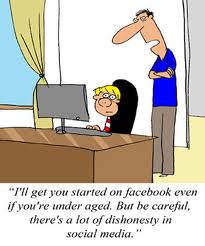

Parents of Underage Facebook Users Should Be Reported: Principal

May 7, 2012

I am a big advocate of Facebook’s age requirement specifications. Children under 13 have no place having a Facebook page. They are simply too young to manage a Facebook page with maturity.

As much as I approve of the age requirements, everyone knows that underage kids have no difficulties getting their Facebook page and Primary schools are teaming with underage Facebook users. This poses deep concerns from a cybersafety and cyberbullying point of view.

However, to suggest that parents of underage children should be reported to child services, both cheapens the important role that child services play in the welfare of our children and labels well-meaning but naive parents as incompetent and unfit for the job:

The issue of underage children creating profiles on social networking sites like Facebook and how to control it can be a problem for both privacy and security — something one UK principal apparently believes should be taken further.

Sister site CNet reports that as there are so many underage children on Facebook — signed up with or without parental consent — one educator believes official, legal consequences for breaking the rules should be put in place.

The school principal of St. Whites School in the Forest of Dean, Paul Woodward, has reason to believe over half of the students in his school are on social networking sites including Facebook. However, the problem is that St. Whites School’s attending students are between the ages of 4 and 11 — far below Facebook’s minimum age in relation to its Terms of Service.

Woodward, speaking to the Daily Mail, believes this issue is serious, and it may be something that official channels should become involved in:

“It’s illegal for you to do this, you shouldn’t be doing it for your child. You need to close down that account, or I might have to tell the safeguarding people that you are exposing your child to stuff that’s not suitable.”

The ’safeguarding people’ are child-protection services, usually reserved for cases of abuse, domestic problems or suspicions of violence. Perhaps this could be considered a drastic move, but as online networks often contain material not suitable for children of a certain age, the logic is understandable. If parents facilitate their child’s access to such networks, then perhaps they can be considered culpable.

A survey completed earlier this year by company Minor Monitor indicated that while over 70 percent of parents were concerned with their child’s activities on Facebook, 38 percent of all children on the social networking site are under 13 — and 4 percent are under 6 years of age.

Facebook says it removes approximately 20,000 underage users daily, but it is also important to note that parents are creating profiles for their children. New parents — you may want to remove that profile you created for your baby. (They probably won’t appreciated their baby photos being online once they’ve grown anyway).

Educating parents is a far more workable strategy than threatening them. I have never heard of a Principal who has gone public with a threat to report half the parents in their school to social services. That’s courage for you!

I commend Mr. Woodward for his conviction and his desire to see that his students stay safe and follow the law. I just think that in doing so, he went way too far.

Too Many Underage Kids Use Facebook

May 11, 2011

I personally believe that the age restrictions for setting up a Facebook page is quite reasonable.  A child 13 and over is able to make far better decisions and possesses a much greater depth of perception and maturity than a pre-teen.  I think it is very unfortunate that millions of children under 13 have bypassed these restrictions and currently have their own Facebook accounts.  The potential harm of misusing Facebook can not be overstated:

Millions of children are active on Facebook in violation of the site’s terms of service, which require users to be at least 13 years old, according to a survey released Tuesday by Consumer Reports.

The magazine said it estimates that 7.5 million of the 20 million minors on Facebook are younger than 13. More than 5 million children in this group are 10 and younger. These youngsters are vulnerable to predators and bullies, as well as Internet viruses and malware, because they are using Facebook with little parental oversight, Consumer Reports said. The magazine said it projects “1 million children were harassed, threatened or subjected to other forms of cyberbullying on the site in the past year.”

Minors can skirt Facebook’s terms of service by falsifying their birth date when they register for the free site. Facebook has procedures in place to find underage users, including reports from other users, and will permanently delete those accounts if detected.

Consumer Reports said the best way for parents to monitor their children’s Facebook activities is to “friend” them via the site. However, only 18 percent of parents of children 10 and younger have done so. This figure rose to 62 percent for parents of children 13 and 14.

In a response to the Consumer Reports survey, Facebook noted that “there is no single solution to ensuring younger children don’t circumvent a system or lie about their age. We appreciate the attention that these reports and other experts are giving this matter and believe this will provide an opportunity for parents, teachers, safety advocates and Internet services to focus on this area, with the ultimate goal of keeping young people of all ages safe online.”

Online security is a concern for adults as well as minors. Consumer Reports’ survey showed that 21 perent of Facebook users with children at home have posted those children’s names and photos on the site. According to the magazine, 15 percent of Facebook users have posted their current location or travel plans and 34 percent have shared their full birth date. This exposes consumers to identity theft and stalking, Consumer Reports said. In addition, one in five Facebook users has not used the site’s privacy controls.

The magazine compiled its results from its national State of the Net survey, which covered 2,089 online households and was conducted earlier this year. About 150 million Americans are on Facebook.

The social networking company has addressed safety as recently as last month, announcing that it has revamped its Family Safety Center, an online portal with resources for parents and teens. Facebook also said in April  that it plans to release a free guide for teachers on how to safely use social media in the classroom.

“We agree with safety experts that communication between parents/guardians and kids about their use of the Internet is vital,” Facebook said, adding: “Just as parents are always teaching and reminding kids how to cross the road safely, talking about internet safety should be just as important a lesson to learn.”

So is it the role of a teacher to teach children about safe internet practices and responsible internet use?  Yes, to an extent.  However, as one of my readers, Anthony Purcell, wrote so succinctly in a comment on a similarly themed post:

I am a little frustrated that teachers are being the ones that are to teach children how to be good digital citizens. Where are the parents? They should be helping out as well. Unfortunately, I know that many parents don’t know how to be a good digital citizen. There are sites out there that teachers can build to help students out with this. Should they be on Twitter and Facebook in primary school? No, but we can set up ways to help them begin their good digital citizenship roles.

I couldn’t agree more.  Parents, we can only do so much to ensure that your children make responsible decisions on the internet as well as in other spheres.  The rest is up to you!