Archive for the ‘Classroom Management’ Category

50 Things You DON’T Have to do to Maintain Classroom Management

September 15, 2013


manage

Courtesy of the brilliant site smartclassroommanagement.com:


1. You don’t have to lecture, yell, or scold.

2. You don’t have to micromanage.

3. You don’t have to ignore misbehavior.

4. You don’t have to be unlikable.

5. You don’t have to tolerate call-outs and interruptions.

6. You don’t have to use bribery.

7. You don’t have to walk on eggshells around difficult students.

8. You don’t have to give false praise.

9. You don’t have to send students to the office.

10. You don’t have to implore your students to pay attention.

11. You don’t have to say things you don’t truly believe.

12. You don’t have to be humorless, stern, or overly serious.

13. You don’t have to repeat yourself over and over again.

14. You don’t have to work on building community.

15. You don’t have to beg or coax or convince your students into behaving.

16. You don’t have to waste time and attention on difficult students.

17. You don’t have to do more or say more to have better control.

18. You don’t have to show anger or lose your cool.

19. You don’t have to lower your behavior standards.

20. You don’t have to talk so much, so often, or so loud.

21. You don’t have to have an antagonistic or demanding relationship with difficult students.

22. You don’t have to shush your students or ask repeatedly for quiet.

23. You don’t have to give frequent reminders and exhortations.

24. You don’t have to show hurt or disappointment to get your message across.

25. You don’t have to guide, direct, or handhold your students through every moment of the day.

26. You don’t have to be thought of as a “mean” teacher.

27. You don’t have to use threats or intimidation to get students to behave.

28. You don’t have to have friction or resentment between you and any of your students.

29. You don’t have to use behavior contracts to turn around difficult students.

30. You don’t have to give over-the-top or gratuitous praise.

31. You don’t have to plead with your students to follow your directions.

32. You don’t have to use different strategies for different students.

33. You don’t have to tolerate a noisy, chaotic, or unruly classroom.

34. You don’t have to talk over your students or move on until you’re ready.

35. You don’t have to accept being disrespected, cursed at, or ignored.

36. You don’t have use complicated classroom management methods.

37. You don’t have to be fearful of holding your students strictly accountable.

38. You don’t have to hold time-consuming community circles or hashing-out sessions.

39. You don’t have to be negative or critical to motivate your students.

40. You don’t have to cover up your personality or hold back from having fun.

41. You don’t have to tolerate arguing and talking back.

42. You don’t have to ask two or three times or more for your students’ attention.

43. You don’t have to offer praise for expected behavior.

44. You don’t have to rely on parents, the principal, or anyone else to turn around difficult students.

45. You don’t have to be overbearing or suffocating to have excellent control.

46. You don’t have to give incessant talking-tos to difficult and disrespectful students.

47. You don’t have to ask students why they misbehaved or force assurances from them.

48. You don’t have to have a boring, no-fun classroom to keep a lid on whole-class misbehavior.

49. You don’t have to be tense, tired, and sick of dealing with misbehavior.

50. You never, ever have to be at the mercy of your students.


Click on the link to read Ten Tips to Minimise Classroom Distractions

Click on the link to read 6 Methods For Getting Kids to Cooperate

Click on the link to read 10 Important Steps to Stop Yelling at Kids

Click on the link to read Classroom Management is Getting Harder

Click on the link to read The Dog Eat Dog Style of Education

Click on the link to read Problem Kids, Suspensions and Revolving Doors

Ten Tips to Minimise Classroom Distractions

August 19, 2013


cell

Courtesy of retired teacher J. Fedder:

1. Whether it is too hot, too cold, or too humid, classroom temperature can affect student comfort. When a student (or teacher) is uncomfortable, focus for that individual shifts from attention to lesson material to finding a way to reduce discomfort. Teachers need to be aware that different areas of the same classroom can have differing temperatures.

2. Classroom lighting is another important factor that can cause a student to wander off task. Both dim light and glare make reading difficult. A wise teacher pays attention to the amount and source of classroom lighting, including glare given off whiteboards or posters. Again, different areas of the same classroom can have differing light. Teachers need to check the quality of light from all areas of the classroom.

3. Visual stimulation works both ways–it can motivate learning or it can disrupt it. Visually stimulating items in a classroom grab student attention. This is helpful when items are used for instructional purposes, but not so helpful, otherwise. Removing an assortment of visually stimulating posters, charts, and doodads from classroom walls, shelves, or desktops, helps minimizes student distraction.

4. Finding a place for student bags and coats that is off to the side, helps minimize distraction. It keeps students from pawing through belongings at inappropriate times. What is not outwardly visible has less power to grab a student’s attention away from the lesson at hand.

5. Row seating may offer an advantage over cluster seating. There are fewer opportunities to talk face-to-face with other students. Rows also allow teacher access to every student. A teacher can move in close and make eye-contact with a single student who needs behavior modification and not need to address or distract a group of students.

6. Minimizing classroom distractions applies to teacher’s clothing choices, as well. Tight-fitting garments, deep-necklines, or busy patterns can distract students. Dangle bracelets and hard-heeled shoes create auditory distractions. The smell of a teacher’s cologne, perfume, or hand fragrance may also prove distracting to a student.

7. Students create classroom noise from coughing, sniffing of runny noses, scooting chairs up to desks, and so on. Having background music or fan noise may help cover some of these sounds, as well as cover sounds coming from nearby classrooms or the hallway. Tennis balls on the bottom of chair legs may help reduce the racket of chairs on hard floor surfaces.

8. Personal wireless devices in a classroom are disruptive. It is best to have students turn off devices during class time or to have devices inaccessible. This minimizes both visual and auditory disruption from wireless devices and curbs cheating.

9. High-traffic areas create a steady stream of distractions. These areas are doorways, around the teacher’s desk, at the pencil sharpener, and at the garbage can. Seating easily distracted students away from high-traffic areas or between students who are less distractible, should lessen distractibility. In some cases, seating a distractible student near the teacher’s desk allows teacher to handle behavior modification without interrupting other students.

10. Facing student desks away from exterior windows, hall doorways, and the teacher’s desk, may be effective in reducing student distraction. Placing garbage cans and pencil sharpeners in areas that already receive high traffic, allows other areas of the classroom to be places of less disruption.


Click on the link to read my post on Disabled Children: A Missed Opportunity for Us All

Click on the link to read my post on Meet the 14-Year-Old on his Way to Becoming a Nobel Prize Winner (Video)

Click on the link to read my post on Treatment of Autistic Children Says a Lot About Our Failing System

Click on the link to read Our Real Heroes are Not Celebrities or Athletes

Click on the link to read Girl Writes Cute Note to the Queen

Click on the link to read Instead of Teaching a Baby to Read, Teach it to Smile

Click on the link to read The 15 Most Commonly Misspelled Words in the English Language

Click on the link to read Who Said Grammar Isn’t Important?

Disabled Children: A Missed Opportunity for Us All

June 29, 2013

disabled

I went to a funeral for a young girl earlier this month. She caught a virus as a baby and spent her short life in a wheelchair, unable to communicate in any meaningful way.

Her father is a family friend of mine and a brilliant parent. His eulogy moved me like a speech never has. He said that having her changed his life. He had never even spent time with a disabled person before he met her, let alone parent one. He said that she showed him what it means to have strength, find pleasure even when under duress and he noted that even though she was never able to say a word, she communicated through her eyes and smile.

He said that he and his wife were adamant that she go to a regular school rather than a school for the disabled. He didn’t want her to feel typecast or branded, so he felt that the conventional classroom experience would be beneficial. He recounted how loyal and caring her classmates were. They would nurture her, make her feel important even when she couldn’t do what they were doing and help her whenever she needed it.  He said that he was stunned that in her dying days, her classmates would regularly make visits to her and tell her stories and share jokes.

He concluded by saying that he know fully appreciates how everyone in this world has a great purpose and a lasting contribution to make. His daughter showed him that much can be achieved, even under the toughest of circumstances.

There was not a dry eye in the house.

Reflecting on the eulogy, I can’t help but wonder if we have the right system in place for educating children with disabilities. Whilst I appreciate that severely handicapped children have special needs which may not be able to be fully accommodated in a regular classroom, it concerns me that our children do not get the opportunity to spend time and communicate with disabled children. It’s almost as if they are purposely separated from each other. Surely, it would make sense to pair our schools with associated schools for the disabled so that there can be days throughout the year where such interaction is possible. By forming alliances with schools for deaf, blind and wheelchair bound students, our students will get a greater awareness of the virtues of disabled children, and the disabled will be able to see the possibilities of making friendships beyond their handicap subgroup.

In my view it’s a clear win/win!


Click on the link to read my post on Meet the 14-Year-Old on his Way to Becoming a Nobel Prize Winner (Video)

Click on the link to read my post on Treatment of Autistic Children Says a Lot About Our Failing System

Click on the link to read Our Real Heroes are Not Celebrities or Athletes

Click on the link to read Girl Writes Cute Note to the Queen

Click on the link to read Instead of Teaching a Baby to Read, Teach it to Smile

Click on the link to read The 15 Most Commonly Misspelled Words in the English Language

Click on the link to read Who Said Grammar Isn’t Important?

6 Methods For Getting Kids to Cooperate

June 6, 2013

Courtesy of lifehacker.com.au:

Invite, Don’t Demand

We all want our children to “ask nicely”, but the truth is that’s easier said than done. My question is, where do you think they learned to be demanding and inflexible? Oh yeah, from us! If we want our kids to cooperate, then we’ve got to be the bigger, more mature ones and lead by example. Contrary to popular belief, asking nicely, inviting, and working together to find a solution to a problem doesn’t teach children to be more defiant or disobedient, instead, by doing these things you’re laying a foundation of trust and teamwork that your kids will soon learn to rely on.

Use this quick test to figure out whether your request is actually a demand. Ask yourself, “Would it be OK if they answered ‘no’ to this request?” If not, then you’re not actually inviting or asking, you’re demanding or requiring a specific behaviour. That’s OK some of the time, especially if safety is an issue, but remember, the more demands you make on your kids, the less true, internally motivated cooperation you’re likely to get.

That’s not to say you shouldn’t have expectations of your children. It’s just that when those expectations aren’t met, it’s helpful to see that as an opportunity to problem solve together, rather than an excuse to punish them into submission.

(more…)

10 Important Steps to Stop Yelling at Kids

May 7, 2013

yell

As much as it is largely ineffective and unprofessional we have all yelled at our students at one time or another. It can be extremely hard to remain calm when students become unruly and uncooperative.

Although intended for parents, this list by Laura Markham, Ph.D. provides sound strategies for maintaining composure around children:

(more…)

Classroom Management is Getting Harder

March 24, 2013

manage

Teacher training really falls flat when it comes to providing new teachers the practical tools to deal with the increasing difficulties of managing a class:

Teachers have warned that disruptive behaviour in classrooms has escalated sharply in recent years, as funding cuts to local services have left schools struggling to cope.

A survey by the Association of Teachers and Lecturers (ATL) found that the vast majority of staff had recorded a rise in the number of children with emotional, behavioural or mental health problems.

The union collated numerous examples of challenging behaviour, ranging from violent assault to defamatory campaigns on social media.

Suggested reasons for the deteriorating behaviour include a lack of boundaries at home, attention-seeking, an absence of positive role models at home, low self-esteem and family breakdown.

The ATL, which has 160,000 members across the UK, said aggressive cuts to the traditional safety net of local services have left schools dealing with complex behavioural and mental health problems on their own.

Earlier this month it emerged that two-thirds of local authorities have cut their budgets for children and young people’s mental health services since the coalition government came to power in 2010. A freedom of information request by the YoungMinds charity found that 34 out of 51 local authorities which responded said their budgets for children’s and young people’s mental health services had been cut, one by 76%.

Alison Ryan, the union’s educational policy adviser, said: “Services are struggling for survival or operating with a skeleton staff, so there’s now a huge pressure on schools to almost go it alone. Schools are absolutely on the front line of dealing with these children and young people and trying to provide a service that means they don’t fall through the cracks.”

, general secretary of the ATL, said: “The huge funding cuts to local services mean schools often have to deal with children’s problems without any help.”

The survey of 844 staff found that 62% felt there were more children with emotional, behavioural and mental health problems than two years ago, with 56% saying there were more than five years ago. Nearly 90% of support staff, teachers, lecturers, school heads and college leaders revealed that they had dealt with a challenging or disruptive student during this school year. One primary school teacher in Cheshire said: “I have been kicked in the head, spat at, called disgusting names, told to eff off, had the classroom trashed regularly and items thrown. We accept children who are excluded from other schools so they come to us with extreme behaviour issues.”

A teacher in a West Midlands secondary school said: “One colleague had a Twitter account set up in front of him on a mobile called Paedo ****** [their name], which invited others to comment on him and his sexual orientation.”

Another teacher in a secondary school in Dudley added: “I’ve been sworn at, argued with, shouted at, had books thrown at me, threatened with physical abuse and had things stolen and broken.”

Bousted added: “Regrettably, teachers and support staff are suffering the backlash from deteriorating standards of behaviour. They are frequently on the receiving end of children’s frustration and unhappiness and have to deal with the fallout from parents failing to set boundaries and family breakdowns.”

On the positive side, most of the disruptive behaviour facing staff was categorised as fairly low level, with 79% of staff complaining that students talked in class, did not pay attention and messed around.

Some 68% added that students were disrespectful and ignored their instructions, 55% said they had dealt with verbally aggressive students, and a fifth with a physically aggressive student. Among secondary and sixth-form students, smoking was considered a significant problem.

On most occasions challenging behaviour was deemed an irritation which disrupted class work, according to 74% of staff, but 42% revealed that they suffered stress and almost a quarter said they had lost confidence at work. Forty of those questioned said they had been physically hurt by a student.

Click on the link to read The Dog Eat Dog Style of Education

Click on the link to read Problem Kids, Suspensions and Revolving Doors

Click on the link to read Useful Resources to Assist in Behavioural Management

Click on the link to read When Something Doesn’t Work – Try Again Until it Does

Sticking Troubled Children in Isolation Booths is a Disgrace

December 2, 2012

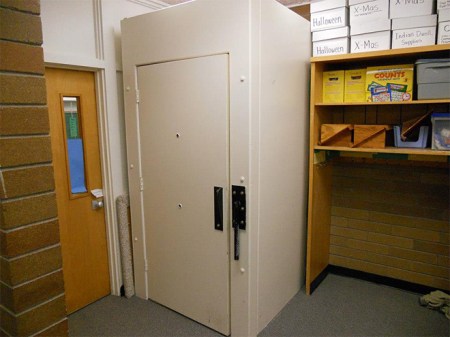
Besides the fact that isolation booths represent the height of cruelty, one wonders how in the age of instant lawsuits and strict health and safety regulations such a monstrosity could ever be used by schools.

Can you imagine the lawsuit that would arise if a child got overheated or had a panic attack in one of those things?

And looking at the contraption, I can’t help but wonder how expensive it would be to get one. How can schools complain about funding when they spend their finances on a booth that will likely emotionally scar its students?

A concerned mother who posted photos of an “isolation booth” in a Longview elementary school on Facebook said she wanted other parents to know how the school uses the space.

Ana Bate said her son saw the booth in use at Mint Valley Elementary School, and had questions.

The school principal said the padded room is used for students who have behavioral disabilities.

Parents of eight or nine students at the school have given permission for their kids to be placed in the booth if necessary.

“How come they’re not providing documentation about how this ‘therapeutic booth’ is beneficial?” said Bate. “Show me some real numbers. Show me something from the medical community that says more times than not and all the documentation that backs it up. Don’t tell me ‘well, their parents said we could do it.’”

The superintendent of Longview Public Schools said the booth is an effective therapy tool for students with special needs, and has been for years.

District spokeswoman Sandy Catt told KATU News students whose parents gave permission are placed in the booth when they are acting in a way that could be harmful to themselves or others.

None of the parents who gave the district permission to place their kids in the booth has complained, Catt said. But because of the many complaints from other parents, the district is reviewing how the booth is used.

“I believe that room has served a good therapeutic purpose and there may be improvements,” said Catt. “I think we need to look at the information that’s been gathered to determine where to go from here.”

Therapy? You have got to be kidding! Successful therapy changes habits and behaviours. This doesn’t change the way children behave. All this does is keeps them in a holding cell so that the teacher can deal with the problem easily and expediently.

But guess what? Education isn’t just about what’s easiest for the teacher. Sure. it’s important that teachers get the support that they need to handle difficult situations, but there is something just, if not more important, than the teacher’s welfare – the students’ welfare.

These booths need to be tossed in the scrap heap. They need to be replaced with people. Councillors, Principals, Aides etc.

An isolation booth further reinforces that the child is different and a problem. Most of these children act the way they do because of real issues they are confronting in their lives. These issues can only properly be worked through by people, not booths.

booth

Click on the link to read The Dog Eat Dog Style of Education

Click on the link to read Problem Kids, Suspensions and Revolving Doors

Click on the link to read You Don’t Get Respect From Punishing Every Disorderly Act

Click on the link to read When Something Doesn’t Work – Try Again Until it Does

You Don’t Get Respect From Punishing Every Disorderly Act

October 23, 2012

The students involved would have got suspended in a less tolerant school. But this teacher shows up trigger-happy schools that suspend like it’s going out of fashion, when he decides to take a more thoughtful approach to reacting to a ruckus:

A Chicago magnet high school senior prank turned into an example of excellent school management when a dean took an unconventional approach to a feisty student’s challenging behavior last Tuesday.

In a video posted on YouTube and social news site Reddit, students on the second floor of Whitney M. Young High School in Illinois decide to stage a dance-battlesque senior prank.

Teens begin to bang on chairs and tables, and the students start hollering. One boy, with the loud support of his peers, runs up to a faculty member’s doorway and dances in front of a woman’s face.

The student then circles the space, looking for another challenger, when a man in a white shirt and tie catches his eye. The young man takes a flying leap, lands in front of the teacher’s nose and begins to dance furiously.

What happens next, however, is both hilarious and unexpected.

Clearly amused, the administrator, identified in the video as Dean of Students John Fanning, takes the boy’s hijinks in stride, breaking out into a dance of his own that looks an awful lot like a version of an Irish jig.

“Like any kid who grew up in [predominantly Irish Chicago neighborhood] Rogers Park, I was dragged to Irish dance classes,” Fanning told The Huffington Post.

The post on Reddit is titled “Teacher strikes back in the best way possible,” and many of the comments commended the teacher for his response. “No one got assaulted, no one got insulted, everything was awesome,” user “ppcpunk” wrote.

Why get angry? Fanning asked. “As senior pranks go, it’s pretty tame and innocuous,” he said.

Click on the link to read The Dog Eat Dog Style of Education

Click on the link to read Problem Kids, Suspensions and Revolving Doors
Click on the link to read Useful Resources to Assist in Behavioural Management

Click on the link to read When Something Doesn’t Work – Try Again Until it Does

Being a Teacher Makes Me Regret the Way I Treated My Teachers

September 10, 2012

I was not an unruly child by any means, but teaching has made me aware of certain instances when I should have been kinder and more thoughtful to my teachers. I have even since apologised to one of my former teachers because of the guilt I had upon this revelation.

I am looking forward to reading Tony Danza’s book “I’d Like to Apologize to Every Teacher I Ever Had”, whose teaching experience led him to the same realization:

When we heard Tony Danza wrote a book about his experiences as a school teacher, we figured that was before his days on Who’s the Boss? But it’s wasn’t and that’s what makes this book so great.

In this brutally honest memoir, Tony Danza gives readers a backstage pass to his year teaching high school English in inner-city Philadelphia, a gig he took after being inspired by a documentary made by Teach for America and decided he wanted to give back.

So, three years ago, he did just that: he became a teacher.

Entering Philadelphia’s Northeast High School’s crowded halls in September 2009, Tony found his way to a tenth-grade classroom filled with 26 students who were determined not to cut him any slack.

They cared nothing about his showbiz credentials, and they immediately put him on the hot seat, asking questions like, “Does anyone else think it’s weird that you’re teaching English?” and “Are you nervous—because, your shirt is totally soaked?”

In this book,Tony shares experiences that ranged from the infuriating to the deeply rewarding as he relives his days at the head of the class.

Click on the link to read The Dog Eat Dog Style of Education

Click on the link to read Problem Kids, Suspensions and Revolving Doors
Click on the link to read Useful Resources to Assist in Behavioural Management

Click on the link to read When Something Doesn’t Work – Try Again Until it Does

Useful Resources to Assist in Behavioural Management

September 4, 2012

A compilation of behavioural management links by the team at The Guardian:

Positive ways to manage behaviour provides a range of techniques from the training organisation Pivotal Education. These include establishing explicit rules and routines, providing students with clear choices regarding their behaviour and starting each day with a clean sheet.

Further advice on some of the most common behaviour problems is contained in Classroom management strategies. Areas covered include dealing with pupils who are defiant, use abusive language, refuse to work or make silly noises in class. The resource highlights “needs-focused interventions”, such as “chunking” tasks to make them more manageable, taking time over your classroom seating plan and encouraging parental involvement. Strategies to avoid include giving ultimatums or tactically ignoring disruptive pupils.

Coping Strategies for Teachers contains tips on preventing, reducing and managing unacceptable behaviour. Ideas include having a challenge on the board for pupils to complete as they arrive in class, giving responsibility to students for activities such as taking the register, and keeping a behaviour file to record any incidents, meetings or contact with parents.

To encourage positive behaviour in early years and primary, Twinkl has created a range of wall display resources. These include a set of posters about good listening and a Noisometer that you can use to set and monitor noise levels in the classroom. To help celebrate good behaviour, there is a set of star of the day and star of the week posters, and as an alternative to the traditional traffic light behaviour management resource, you can use a set of Behaviour Management Dragons to give warnings for misbehaviour in a calm, non-confrontational way.

For newly-qualified teachers, a list of 10 top tips has been created by assistant headteacher and mentor Eugene Spiers. Advice includes remembering to smile and greet your classes, even the groups you dread, being consistent with praise and sanctions and calling a selection of parents with good news every Friday. There is additional advice in the resource 10 top tips for NQTs.

On a lighter note, Five Minutes to a Calmer Classroom provides tips on using meditation in the classroom. It includes details of a simple breathing exercise that can be used to tackle stress and improve concentration.

And for anyone starting the new school year as a supply teacher, there is a list of top tips from primary teacher Colin Cartmell-Browne. Advice includes arriving as early as possible, making a note of the school timetable and discussing with other members of staff whether there are any pupils who will need additional support.

Click on the link to read The Dog Eat Dog Style of Education

Click on the link to read Problem Kids, Suspensions and Revolving Doors
Click on the link to read The Solution to the Disruptive Student Has Arrived: Body Language Classes

Click on the link to read When Something Doesn’t Work – Try Again Until it Does