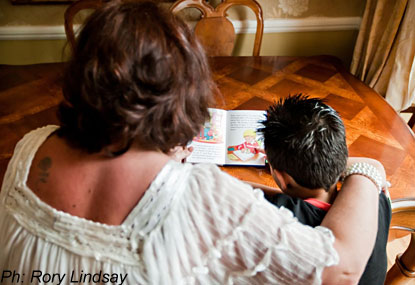
I read a disturbing article about a young boy who struggles with dyslexia, and the trauma his mother has gone through as his school makes little to no effort to assist him. It is a difficult article for a teacher to read, but a very important one. There are too many students that fall between the cracks. Too many that don’t get the attention and support that they so desperately need. As teachers, we must fight for the social, emotional and academic wellbeing of all our students, whilst ensuring that they are all, without exception, getting the care and attention they need.
Below is an excerpt of the article. I truly recommend that you read the whole story,
David is an artistically gifted boy with a photographic memory. The 10-year-old’s dining-room table is full of intricately designed Lego battleships, his art displays such originality that his teacher calls him “the next Picasso”, and he has an extraordinary ability to recall facts from the History Channel documentaries he watches on TV.
“The other day,” his 41-year-old mother Margaret recalled, “we were driving along and he said, ‘mummy, you were born in the year the first man landed on the moon’.”
But there is one big problem with David that overshadows his life. He cannot read. He has been assessed as “severely dyslexic” and “having the reading age of a child aged four years and four months”. His schooling has been a disaster and according to educational psychologist reports seen by the Standard, he has progressed “just one month in five years”.
You might assume that David attends a failing, inner-city school, but you would be wrong. His south London state primary is rated “good” by Ofsted, attended almost exclusively by white British-born pupils, and is located in a street of £3million houses. He is also well behaved.
Yet David, his mother said, has been “catastrophically let down by everyone: by his teachers, by the school and by the council”, all of whom failed to give him the specialised help he needs.
Margaret said: “At school the other kids call him ‘odd’ and ‘weirdo’ and he often comes home crying. He is still reading flashcards and has not progressed beyond words like ‘cat’ and ‘dog’. He has no real friends – how can he? He doesn’t get their jokes or their games. To the other kids, he is a misfit who doesn’t understand anything that’s going on because he can’t read.”
“My son was nine and he still couldn’t read a word,” said Margaret. “What were they waiting for? Why didn’t they do something?”
Finally the school arranged for David to have some specialist teaching – three hours a week at a nearby literacy centre at a cost to the school of £1,000 a term – as well as 15 hours a week one-on-one with the teacher assistant. For the first time he made a glimmer of progress, improving by “one month in a year”. Margaret says the teacher assistant and the literacy centre are not experts in teaching severely dyslexic children.
There is a growing tendency to allow students to pass the year, regardless of their level of skill or maturity. The reason for this is quite sensible. Holding a child back can have strong emotional repercussions. But because such a system exists, not enough questions are asked of students who are languishing.
I am not suggesting for a second that young David should have been kept down. I am simply suggesting that since teachers no longer have to explain why a child is ready to be promoted, there is less incentive to put the time and energy into children like David.
It is time that we looked into the issue of students being promoted without the basic skills, and ensure that teachers are made accountable for the progress of their students. David was allowed to fall into the gaps and starved of the support he needed because there isn’t enough pressure on teachers to reach benchmarks.
The story of David breaks my heart because he is a victim to poor teaching, an inept education system and a misnomer that dyslexia renders one academically incapable.
Tags: Bullying, Dyslexia, Education, Learning Difficulties, Literacy, Ofsted, Parenting, Psychology, Reading, Schools, Teachers, Teaching
 Topical Teaching
June 21, 2011 at 9:41 am |
This is an extreme example but it makes the point that our educational system often does not take into account the various learning styles of its students. There are many ways to obtain knowledge besides reading and in this high-tech age, there’s no excuse for not using everything available to help a kid get ahead. In the corporate world, there are tons of experts who consult on personality typing and learning style assessment. There seems to be a huge opportunity for experts to apply some of this knowledge in schools.
When a child has difficulty reading, the solution isn’t always as simple as “practice makes perfect.” Depending on the reason for the difficulty, different techniques may be required. It just seems that there’s a lot of one-size-fits-all troubleshooting these days. It’s frustrating.
June 22, 2011 at 9:50 am |
Powerful–thank you.