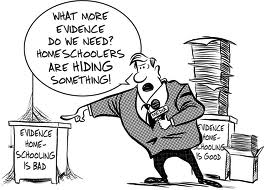
Whilst I am not a proponent of homeschooling and I see the virtues of the traditional school system, I am very frustrated by the lack of tolerance given to parents who decide that homeschooling is their prefered option. To knock homeschooling is to ignore the many serious flaws inherent in the traditional school system. Even though I think these flaws can be corrected and better practice can be implemented, until that is the case, parents will always look at their options.
That’s why I was particularly disappointed to read a recent article regarding the 12,000 children, aged 16 or under who are classed as “missing” from school in England.
The figures prompted warnings about the safety of those allowed to slip through the net. Children allowed to drop out of school could be at “serious risk” of physical, sexual or mental harm, charities said.
A Commons Education Select Committee inquiry in October reported that thousands of children as young as 11 who were “lost” to the education system may be turning to lives of crime, drugs and prostitution.
At this pont of the article I was naturally concerned about these kids who are so young, yet are not receiving education. Then I read the following sentence:
Children may go “missing” due to being forced to wait for a school place or being kept at home by their parents…
How are those scenarios considered “missing?” What if a child is being homeschooled? Are they missing then? Surely children waiting for a school place and being kept home by their parents aren’t necessarily “missing”.
Luckily I read another article which focussed on ending home-school stereotypes:
Despite successes with the ACT, spelling bees and math contests, home-schooled children battle a stereotype that they’re social misfits leading sheltered lives that fail to prepare them for the real world. Or worse yet, home schooling is depicted as brainwashing by parents pursuing a narrow political or religious agenda.
Nebraska law is friendly to home-schoolers, requiring basically that parents submit a form affirming their intent to home-school and provide a copy of their curriculum. The state doesn’t require state testing or home visits by state personnel.
Several parents interviewed said they cope with public misconceptions about home schooling even as the Internet and creative teaching arrangements give parents new ways to broaden their children’s education and further challenge the stereotypes.
Home-schooled students play on Little League teams, join Boy Scouts, perform in public school bands, participate in cooperative academic classes and, when necessary, take classes at local high schools and colleges, parents say. Students participate live in classes via the Internet.
Mike and Tricia Croushorn of Omaha home-schooled their children, Abi, 22, Tyler, 20, and Sam, 16, to give them a well-rounded education that included a religious component.
The Croushorns got interested after getting to know parents who home-schooled.
“We would meet these other children and they were always polite and respectful, and they could carry on a conversation with adults,” Tricia Croushorn said.
Homeschooling is not the enemy of education. Bad teaching and poorly run schools are the enemy of education. Until traditional schools really do offer the kind of support, care and safety that they claim to, then loving parents will always explore their options. Because ultimately it’s not about tradition, it’s about the best needs of our children. The only people who should be making that call are the parents.
I love being a school teacher and I see great value and potential in traditional school education, but I admire the selflessness and sacrifice that homeschooling parents make and the intentions behind their decision. Instead of picking on the unconventional, make the conventional much better than it currently is.
Tags: Children, Education, Family, Home Schooling, Homeschooling, kids, life, Parenting, School, Teaching
 Topical Teaching
February 27, 2011 at 5:34 am |
I’ve seen both good and bad examples of home schooling: 8th graders working at college level, and 18-year-olds who read and wrote and a 4th-grade level. Like any other form of education there are both successes and failures. Some parents do a much better job of tailoring the education of their children than the schools do, and some do much worse.
It is hard to get good statistics on the overall success of home schooling, since there is no requirement (in most places) for home schoolers to be tested on the same instruments used to test kids in school, so there is strong selection bias.
I’ve considered every year whether to home-school my son, and each year some school (private or public) has looked like a better choice for that year. Math is more easily done through home-schooling or online courses than at the public school. Lab sciences are more easily done at school. Theater is readily available for home schoolers (and higher quality than theater in the schools here). Spanish language instruction is much cheaper and better in the schools. If we could find good instruction for writing and Spanish outside the school system, we’d be more likely to choose home schooling for next year.
March 14, 2013 at 3:55 am |
Dear Michael,
You say that you don’t recommend homeschooling. As a parent of four (soon to be five) I am giving more and more thought to this option. Please share your own thoughts on the subject.